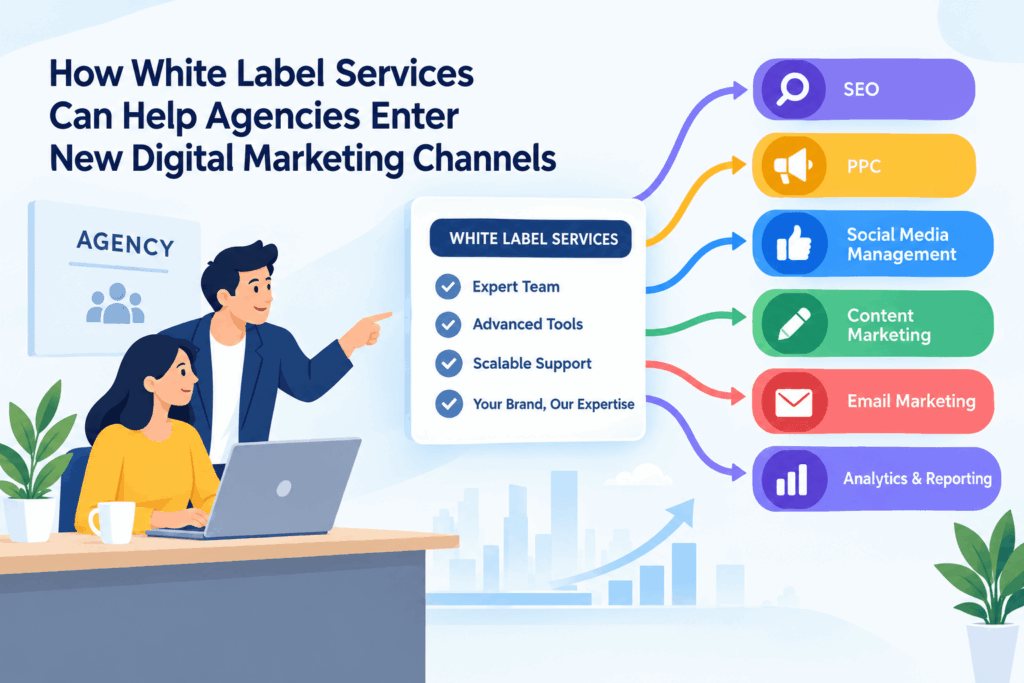
Clients are always looking for new ways to reach their audiences. One wants paid social, another asks about email, and a third wonders if conversion rate optimisation (CRO) could lift their enquiries. If your agency can’t deliver any of that, those accounts may stop growing, or the work may go to someone who can.
Adding a channel isn’t as simple as selling another service, though. You need the skills, tools, processes and people to run it properly.
White label services give you a way in without building every team yourself. You partner with specialists, sell their work under your own brand, see whether clients actually want the service and grow at a pace that suits you.
Why Should Agencies Expand into New Digital Marketing Channels?
A narrow service list can hold an agency back. As clients’ businesses develop, their marketing needs change, and many start looking for a partner who can cover more than one channel.
Widening your offer can help you:
- Respond to what clients ask for. When an existing client wants to try something new, you can say yes.
- Grow revenue from accounts you already have. Selling a complementary service to a current client is usually easier than winning a new one.
- Build stronger relationships. Clients like having one agency pull their marketing together.
- Reach new markets. You can take on businesses that need more than your current specialism.
- Stay competitive. You don’t have to wait months to recruit and train before responding to a client’s request.
The real challenge is expanding without letting the quality of your current work slip. That’s where a white label partner helps.
What Are White Label Services?
With white label services, one company does the work and another sells it as its own.
Say a web design agency wants to offer SEO. It doesn’t hire specialists. Instead, it partners with a white label provider that handles keyword research, technical audits, content optimisation and reporting. The agency looks after the client, checks the work and delivers it under its own branding, while the provider stays out of view.
The agency gets extra expertise, and it keeps control of what it sells and how it talks to clients.
How White Label Services Help Agencies Enter New Channels
1. Add Services Without Hiring Specialists
Every marketing channel needs different skills, workflows and tools, so building a team for each one gets expensive fast.
With white label digital marketing services, you can bring in PPC, paid social, email or SEO without recruiting dedicated staff first. Start with whatever clients request most often, then expand as demand grows. That way you’re not carrying large fixed costs for an opportunity that hasn’t proven itself yet.
2. Test a Channel Before You Commit
Not every channel suits every agency or client. Hiring a full-time specialist before you know there’s demand can put real pressure on your finances.
A white label partner lets you try a service on one defined project or with a few clients. If several clients are curious about LinkedIn advertising, for instance, you can have a specialist run the first campaigns. Then look at the results, the client feedback and whether the numbers work before deciding to go further.
You end up deciding on evidence rather than a hunch.
3. Tap Into Expertise Across Channels
Each channel has its own demands. SEO leans on technical optimisation and organic visibility. Paid advertising means campaign management, budget allocation and ongoing analysis. Email depends on segmentation, relevant messaging and deliverability, and social ads need creative testing and careful targeting.
A specialist partner brings those skills to you, so your team doesn’t need to learn every discipline from the ground up. Your own people can concentrate on client goals, strategy and making sure each channel supports the bigger marketing plan.
4. Build a More Joined-Up Strategy
New channels often work better alongside what a client is already doing. An agency offering SEO could add paid search to reach the right people while organic visibility builds. Content marketing supports SEO, and email helps a business keep in touch with subscribers it already has.
White label partnerships make it easier to bring these together under one agency relationship.
That said, a longer service list isn’t automatically better. Each channel should match the client’s audience, budget and goals.
5. Grow Delivery as Demand Grows
A new service might start with a single client and slowly become a big part of your business. White label support lets you handle that growth without immediately expanding your permanent team. Depending on the partner’s capacity and terms, you can ask for more help as new projects arrive.
That flexibility is useful when workloads rise and fall, and you can keep your usual delivery processes in place.
Which Digital Marketing Channels Can You Introduce?
The right ones depend on your current services, what clients want and where you’re trying to go.
- Search engine optimisation (SEO): Good for clients who want better organic visibility, site performance and relevant search traffic.
- Pay-per-click advertising (PPC): Reaches targeted audiences through paid search and other ad formats.
- Paid social media: Lets you run campaigns on platforms such as Meta and LinkedIn, depending on who the client wants to reach.
- Email marketing: Keeps customers engaged through newsletters, automated sequences and segmentation.
- Content marketing: Adds blog writing, landing page copy and content planning to what you already offer.
- Conversion rate optimisation (CRO): Aims to increase the share of visitors who take an action, such as sending an enquiry or buying something.
Before you add one, ask whether it sits well with your current services and answers a genuine client need.
Read More: White Label Guest Posting: How Agencies Outsource Content-Based Link Building
How to Introduce a New Channel Through a White Label Partner
Putting a service on your website doesn’t mean you can deliver it at a profit. A clear process helps.
- Spot the opportunity. Look through client feedback, repeated requests and gaps in your current offer.
- Pick the channel. Go for services that match client objectives and have realistic room to grow.
- Vet the provider. Check their experience, delivery process, reporting, communication and capacity.
- Agree the commercials. Settle fulfilment costs, deliverables, deadlines, revisions and who reports what. Make sure your client pricing covers your own management time and running costs.
- Roll it out carefully. Offer it to one suitable client or a handful of accounts, set clear objectives and review performance before going wider.
- Refine, then scale. Use results, client feedback and delivery costs to decide whether to tweak the process, change your pricing or add capacity.
Taking it in stages protects the client relationships you already have.
How to Choose the Right White Label Partner
Your partner’s work reflects on your agency, so be picky. Before you commit, look at the following:
- Experience in the channel. They should have delivered the kind of work you plan to sell.
- Quality control. Find out how deliverables are reviewed and how problems get fixed.
- Clear reporting. You need information that helps you explain results to clients.
- Flexibility. Check whether they can handle one-off projects as well as ongoing campaigns.
- Confidentiality. Ask how they manage client data, account access and branded deliverables.
- Clear commercial terms. Know the pricing, minimum commitments, turnaround times and what support is included.
Expand Your Agency’s Capabilities with White Label Services
Moving into a new digital marketing channel can help you serve clients more fully, earn more and strengthen your position in the market. Lasting growth still depends on having real expertise and enough capacity behind every service you sell.
White label services let you explore new channels, respond to client demand and widen your offer without building everything in-house.
Wildnet Technologies supports digital agencies with white label solutions across SEO, PPC, content marketing, social media and other digital services. With an experienced partner handling delivery behind your brand, you can spend your time on client relationships, new business and strategy.
Frequently Asked Questions
1. How can agencies decide which digital marketing channel to add first?
Agencies should start by reviewing client requests, existing service offerings, target audiences and business goals. Choose a channel that complements current services and addresses a clear client need. Starting with a small project can help assess demand, delivery costs and results before expanding the offering.
2. Can small digital marketing agencies offer multiple services through white label partnerships?
Yes, small digital marketing agencies can offer multiple services through white label partnerships without hiring specialists for every channel. They can work with experienced providers for services such as SEO, PPC, email marketing and social media, while managing client relationships and delivering the work under their own brand.
3. Can agencies combine multiple white label services for the same client?
Yes, agencies can combine multiple white label services to support a client’s broader marketing goals. For example, SEO and PPC can help improve search visibility, while content marketing and email campaigns support audience engagement. The services should align with the client’s objectives, budget and target audience.
4. How do agencies maintain service quality when outsourcing digital marketing work?
Agencies can maintain service quality by setting clear deliverables, deadlines and performance expectations with their white label partners. Reviewing completed work, monitoring campaign results, maintaining regular communication and establishing consistent reporting processes help ensure that outsourced services meet client requirements and agency standards.