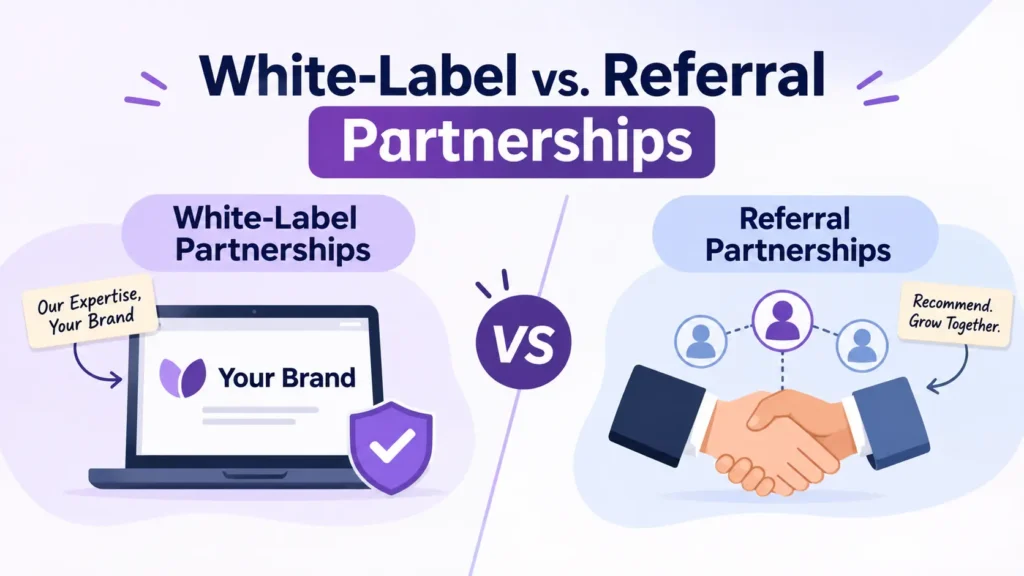
Growing a digital agency requires more than acquiring new clients. Agencies must also decide how to expand their service offerings, manage delivery costs, and build sustainable revenue streams. Two common approaches are white-label partnerships and referral partnerships. Both help agencies collaborate with other businesses, but they differ in how services are delivered, how clients are managed, and how revenue is generated.
Understanding these differences can help you choose the right partnership strategy for your agency’s goals. Whether you want to expand your service portfolio or earn additional revenue by connecting clients with trusted providers, the right approach can create new growth opportunities.
What Are White-Label Partnerships?
White-label partnerships allow an agency to offer services delivered by another company under its own brand. The external provider handles the execution, while the agency maintains the client relationship and presents the work as part of its own service offering.
For example, a digital marketing agency that specializes in SEO may partner with a white-label provider for website development, content creation, or technical SEO. The agency sells these services to clients, manages communication, and reviews the deliverables before presenting the completed work.
This approach allows agencies to expand their capabilities without hiring specialists for every service.
The white-label business model works particularly well for agencies that want to build a comprehensive service portfolio, retain control over the customer experience, and generate revenue from services they do not deliver entirely in-house.
What Are Referral Partnerships?
Referral partnerships involve recommending another business to a prospective client in exchange for a referral fee, commission, or mutually agreed benefit. Unlike white-label arrangements, the referring agency typically does not deliver or manage the partner’s services.
For example, an SEO agency may refer a client who needs custom software development to a trusted development company. The development company handles the proposal, contract, project execution, and client communication. The SEO agency receives a commission if the referral agreement includes one.
These referral partnerships help agencies expand their professional networks and create additional revenue opportunities without taking responsibility for service delivery.
They can also strengthen client relationships by connecting customers with specialists who can address needs beyond the agency’s core expertise.
White-Label vs. Referral Partnerships: Key Differences
Although both approaches help agencies collaborate with external providers, their operating models and business outcomes differ.
| Comparison factor | White-label partnerships | Referral partnerships |
| Service delivery | The partner delivers work under your agency’s brand | The referred business delivers work under its own brand |
| Client relationship | Your agency generally manages the client | The partner generally manages the referred client |
| Revenue model | Your agency earns through service pricing and margins | Your agency may earn referral fees or commissions |
| Operational involvement | Requires coordination, quality checks, and account management | Usually requires less ongoing involvement |
| Brand visibility | Services strengthen your agency’s branded offering | Referrals can strengthen your network and reputation |
| Growth potential | Helps expand service offerings and client accounts | Helps generate opportunities through recommendations |
| Main consideration | Delivery quality and project management | Referral terms and partner reliability |
The best option depends on whether your agency wants to own the service experience or focus on connecting clients with external experts.
How White-Label Partnerships Help Agencies Grow
White-label partnerships are suitable for agencies that want to increase their service capabilities without significantly expanding their internal teams.
1. Expand Your Service Portfolio
Clients often prefer working with a single agency that can coordinate multiple digital marketing requirements. White-label arrangements make it possible to offer SEO, web design, content marketing, paid advertising, and other complementary services through external specialists.
These white-label agency services can help your business serve a wider range of client needs without developing every capability internally.
2. Maintain Control Over Client Relationships
With a white-label model, your agency remains the primary point of contact. You can manage proposals, pricing, communication, and reporting while the partner focuses on execution.
This arrangement supports a consistent brand experience and creates opportunities to build long-term client relationships through bundled services and ongoing contracts.
3. Generate Revenue From Additional Services
Agencies can set their own selling prices based on delivery costs, account management expenses, and the value provided to clients. When managed effectively, the difference between revenue and associated costs can generate a sustainable profit margin.
However, profitability depends on pricing, service quality, client retention, and the resources required to manage each account.
4. Scale Without Hiring for Every Skill
Recruiting and training specialists can require considerable time and investment. White-label partnerships provide access to external expertise when demand increases, allowing agencies to expand more flexibly.
Agencies must still manage workloads, review deliverables, and ensure partners can meet deadlines as project volumes grow.
How Referral Partnerships Help Agencies Grow
Referral partnerships offer a different route to growth, particularly for agencies that want to keep their operations focused.
1. Create Additional Revenue Opportunities
Referral agreements can generate commissions or fixed fees when a referred prospect becomes a customer. This allows agencies to monetize their professional network without managing the complete delivery process.
The financial benefit depends on the agreement, referral conversion rate, and the services being recommended.
2. Reduce Operational Responsibilities
Since the receiving business handles service execution and client management, the referring agency generally spends less time coordinating projects.
This makes referrals useful when clients request services outside the agency’s expertise or when the agency lacks the capacity to manage additional work.
3. Strengthen Your Professional Network
Working with reliable providers can help agencies build a network of specialists across complementary industries. These relationships can improve client satisfaction by making it easier to recommend relevant solutions.
Strong referral relationships also create opportunities for reciprocal recommendations, helping both businesses reach potential customers.
Which Partnership Model Should Your Agency Choose?
The right approach depends on your business objectives, available resources, and desired level of client involvement.
Choose white-label partnerships if you want to expand your service portfolio, maintain control over the customer experience, and generate revenue from ongoing service delivery. They are especially useful when clients regularly request services that complement your existing offerings.
Choose referral partnerships if you prefer a lighter operational model, want to monetize your network, or regularly encounter client requirements outside your expertise.
You do not necessarily have to choose only one. Many agencies use both white label partnerships and referral arrangements. For example, an SEO agency may offer white-label content marketing and technical SEO while referring complex software development projects to a specialist partner.
Before entering any partnership, define responsibilities, payment terms, confidentiality requirements, communication expectations, and procedures for resolving disagreements. Review performance regularly to ensure the relationship continues to support your agency’s goals.
Conclusion
White-label and referral partnerships can both contribute to agency growth, but they serve different purposes. White-label arrangements help agencies expand their branded offerings and retain greater control over service delivery. Referral arrangements make it easier to connect clients with external specialists while keeping operational involvement relatively low.
For agencies seeking to build a broader service business, white-label partnerships can provide a path toward recurring revenue and stronger client relationships. For those prioritizing flexibility and lower delivery responsibilities, referrals may be a better fit.
A balanced strategy can combine both models, enabling your agency to deliver core services through trusted partners while referring specialized projects that fall outside your capabilities.
Frequently Asked Questions
1. What Is the Difference Between White-Label and Referral Partnerships?
White-label partnerships allow an agency to sell services under its own brand while an external provider handles delivery. Referral partnerships involve connecting clients with another business, which typically manages the relationship and service delivery directly.
2. Are White-Label Partnerships More Profitable Than Referral Partnerships?
White-label partnerships can generate higher revenue per client because agencies set service prices and retain the margin after costs. Referral partnerships generally involve less operational work but may provide only a fixed fee or commission. Actual profitability depends on costs, contract terms, and client demand.
3. Which Partnership Model Is Better for Small Digital Agencies?
White-label partnerships are useful for small agencies that want to offer more services without hiring additional specialists. Referral partnerships are suitable for agencies that want to remain focused on their core offerings and avoid additional delivery responsibilities.
4. How Can Agencies Find Reliable White-Label Partners?
Agencies should evaluate potential providers based on relevant experience, portfolio quality, pricing, communication, confidentiality, and delivery capacity. Starting with a small project can help assess the provider’s reliability before entering a long-term agreement.
5. Can an Agency Use White-Label and Referral Partnerships Together?
Yes. Agencies can use white-label partnerships for services they want to sell under their own brand and referral partnerships for services they do not want to manage. This combined approach helps agencies meet more client needs while maintaining control over their workload and growth strategy.