
Summary
In 2026, enrollment funnels are no longer linear; they are intelligent and intent-driven ecosystems. Education marketing companies are using AI insights, behavioural data, and trust-led content to guide students from discovery to enrollment. This blog explains how modern funnels work and how marketing agencies like Wildnet’s are helping EdTech brands consistently maximize enrollments.
Key Takeaways
- EdTech funnels in 2026 are multi-touch, not linear.
- Intent-based marketing strategies outperform generic campaigns.
- Speed, personalization, and trust signals drive quick conversions.
- AI + human strategy is the winning combination for Brands in 2026.
- Structured funnel systems deliver predictable enrollments.
Table of Contents
- A few facts about Education Marketing in India
- Why Funnels Have Changed in 2026?
- Conversion Triggers That Actually Work in 2026 for EdTech
- Common Mistakes Institutions Still Make
- How Leading EdTech Brands Maximize Enrollments with Wildnet’s Funnel Systems?
- Conclusion
- FAQs
Students & learners in 2026 don’t follow a predictable journey.
They search, compare, validate, and even rely on AI tools before making decisions. This shift has forced education marketing companies to completely rethink how enrollment funnels are built.
Instead of pushing applications, the focus is now on guiding students through a decision journey—balancing information, trust, and timely engagement.
This is where modern education marketing agencies are outperforming traditional approaches.
A few facts about Education Marketing in India
- In 2025, 62% of student enrollments were driven by digital channels.
- As per ET Education, 71.78% of leads, 77.96% of applications and 61.55% of learner enrollment in India were due to digital media.
- The EdTech ads spending is increasing at a rate of 50% Y-o-Y.
- As per Reuters, India has 1 billion+ internet users and 500 million+ social media users.
- 47% of students across the globe are using social media to research new learning opportunities.
Why Funnels Have Changed in 2026?
Earlier, EdTech marketing funnels were simple:
Ad → Landing Page → Form Fill → Admission
Now, the journey looks like:
Search → AI Suggestion → Social Proof → Website → Webinar → Counselling → Enrollment
This is literally too much for a brand’s inhouse marketing team to handle and that’s why top education marketing firms are needed. Modern education marketing companies understand that students require multiple trust-building interactions before converting.
That’s why funnels today are:
Non-linear | Multi-platform | Behaviour-driven
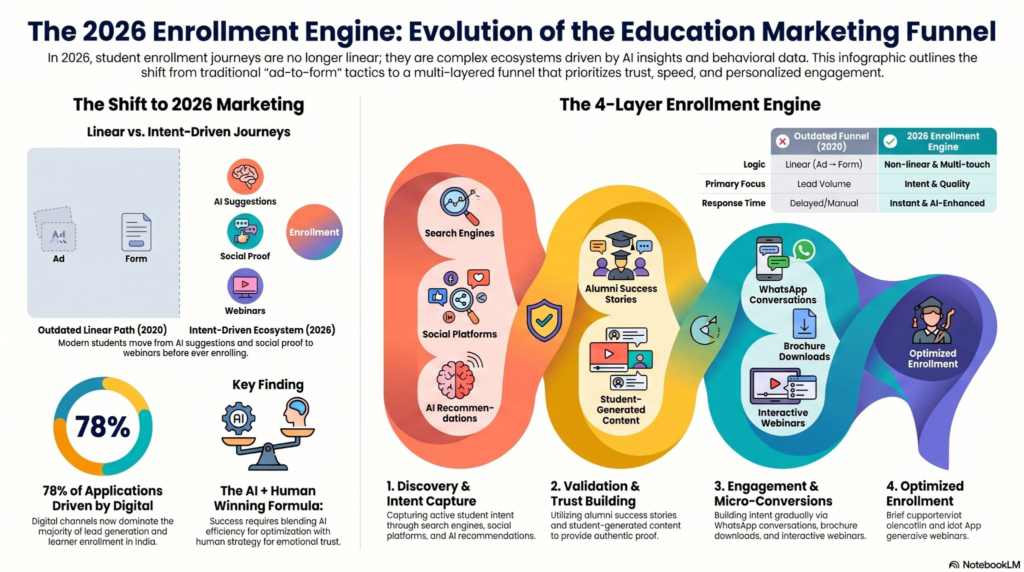
2026 EdTech Enrollment Funnel
The Core Funnel Framework Used Today
Here’s how the model education marketing funnel looks like,
1. Discovery Layer (Awareness + Intent Capture)
This is where education advertising plays a major role. Key channels include:
- Search engines
- Social platforms
- AI-driven recommendations
The focus is on capturing intent, not just impressions.
2. Validation Layer (Trust Building)
Students trust proof more than promotions. Effective funnels include:
- Alumni success stories
- Placement transparency
- Student-generated content
This improves education lead generation quality significantly.
3. Engagement Layer (Micro-Conversions)
Students don’t apply instantly; they engage first. Key actions include:
- Brochure downloads
- Webinar registrations
- WhatsApp conversations
Top education marketing companies design these touchpoints to build intent gradually.
4. Conversion Layer (Enrollment Decision)
At this stage, speed and clarity matter most. Winning strategies include:
- Instant callbacks
- Personalized counselling
- Simplified application journeys
And to further empower these funnel layers, brands need to use AI marketing tools & insights, while a human expert cross checks them.
Role of AI in Funnel Optimization
First things first, AI is enhancing, not replacing, marketers. Google and user experience (UX) are making sure that an AI + Human way is given the best priority.
In 2026, EdTech AI marketing is used for:
- Predicting student behaviour
- Personalizing user journeys
- Automating communication
- Optimizing campaigns in real time
And human strategy remains essential for building trust & emotional connection. That’s why top education marketing companies blend AI efficiency with human insight.
Conversion Triggers That Actually Work in 2026 for EdTech
Only a few elements truly drive conversions today in the education sector:
1. Personalization: Students expect tailored communication.
2. Speed: Faster responses increase conversion probability.
3. Social Proof: Real experiences outperform brand claims.
4. Omnichannel Presence: Consistency builds trust across platforms.
5. Transparency: Clear outcomes improve decision-making.
Common Mistakes Institutions Still Make
Many institutions struggle because they:
- Prioritize lead volume over quality
- Ignore intent-based strategies
- Delay follow-ups
- Use generic messaging
- Fail to optimize funnels continuously
This is where experienced education marketing companies create measurable impact.
How Leading EdTech Brands Maximize Enrollments with Wildnet’s Funnel Systems?
Most institutions believe enrollments come from better campaigns. In reality, they come from better systems. That’s where Wildnet differentiates itself among education marketing companies by building end-to-end enrollment engines, not isolated campaigns.
1. Intent Mapping Before Campaign Execution
Unlike many education marketing agencies, Wildnet starts with student intent, not platforms. This includes:
- Understanding search behaviour
- Identifying decision triggers (ROI, placements & fees)
- Aligning content and ads accordingly
This makes education advertising more conversion-focused.
2. High-Intent Education Lead Generation
Instead of chasing volume, we focus on:
- Filtering low-intent users
- Targeting high-conversion audiences
- Improving lead quality
This transforms education lead generation into a results-driven process.
3. Real-Time Engagement Systems
Speed is critical in delivering digital marketing for educational institutions. Wildnet enables:
- Instant WhatsApp interactions
- Quick response systems
- Personalized follow-ups
This reduces drop-offs significantly.
4. AI + Human Conversion Strategy
Our approach to EdTech AI marketing combines:
- AI for targeting and optimization
- Human expertise for storytelling and trust
This ensures both scale and authenticity.
5. Continuous Funnel Optimization
Wildnet treats funnels as evolving systems. Our champs:
- Track user behaviour across stages
- Test creatives, messaging, and CTAs
- Optimize continuously
This is what drives consistent enrollment growth.
The Outcome
With structured systems in place, our EdTech clients achieve:
- Higher conversion rates
- Better-quality applicants
- Lower cost per enrollment (CPE)
- Predictable growth
This is how modern education marketing companies, like Wildnet, turn marketing into measurable enrollment outcomes.
Conclusion
In 2026, enrollment success is no longer about visibility; it’s about marketing systems. Institutions relying on outdated approaches face low conversions, high acquisition costs, and unpredictable admissions.
But those adopting structured & intent-driven funnels, like Wildnet’s are building scalable enrollment engines. Because today, growth doesn’t come from running campaigns. It comes from building systems that convert, consistently.
Wildnet Technologies Ltd is a trusted EdTech Marketing Partner for brands across India because of our AI + Human marketing approach.
Wish to read more?
> Physics Wallah Case Study: The EdTech Growth Playbook That Left Competitors Behind
> EdTech Social Media Marketing Trends You Can’t Ignore in 2026
> Why EdTech Growth Breaks & Education Marketing Fixes It?
Connect with us at info[@]wildnettechnologies.com and experience the power of AI.
FAQs
Question 1: What do Education Marketing Companies do in 2026?
Answer 1: They build data-driven & multi-channel funnels that attract, engage, and convert students efficiently.
Question 2: How is education marketing different in 2026?
Answer 2: It focuses on intent, personalization, and multi-touch engagement rather than single-step conversions.
Question 3: What role does AI play in education marketing?
Answer 3: AI tools help analyze user behaviour, personalize journeys, and optimize campaign performance.
Question 4: How can institutions increase enrollments?
Answer 4: By focusing on high-intent audiences, faster response times, and structured funnel strategies.
Question 5: Why is digital marketing essential for educational institutions?
Answer 5: Because students rely heavily on online research before making enrollment decisions.