
Summary
Education Lead Generation is becoming increasingly expensive in 2026 due to rising competition, AI-driven bidding wars, declining organic reach, and evolving user behaviour. This newsletter breaks down the key factors driving costs and what EdTech leaders must do to stay ahead.
Key Takeaways
- Education lead generation costs are rising due to competition and AI-led ad auctions.
- Conversion rates are declining despite higher spend.
- Organic visibility is shrinking with AI Overviews.
- First-party data is now critical for sustainable growth.
- AI + human strategy is the future of education marketing.
Table of Contents
- A few facts about EdTech Lead Generation
- Why Education Lead Generation Costs Are Rising?
- What EdTech Leaders Must Do Next?
⤷ How Wildnet Technologies Can Help Your EdTech Business in India?
If you’re an EdTech CMO in 2026, you’ve likely noticed one thing:
Your budgets are increasing.
But your efficiency isn’t.
Education lead generation is no longer just about scaling campaigns. It’s about managing rising acquisition costs while maintaining lead quality. From educational advertising becoming more competitive to AI marketing services driving aggressive bidding strategies, the landscape has fundamentally shifted.
More spending no longer guarantees more growth.
A few facts about EdTech Lead Generation
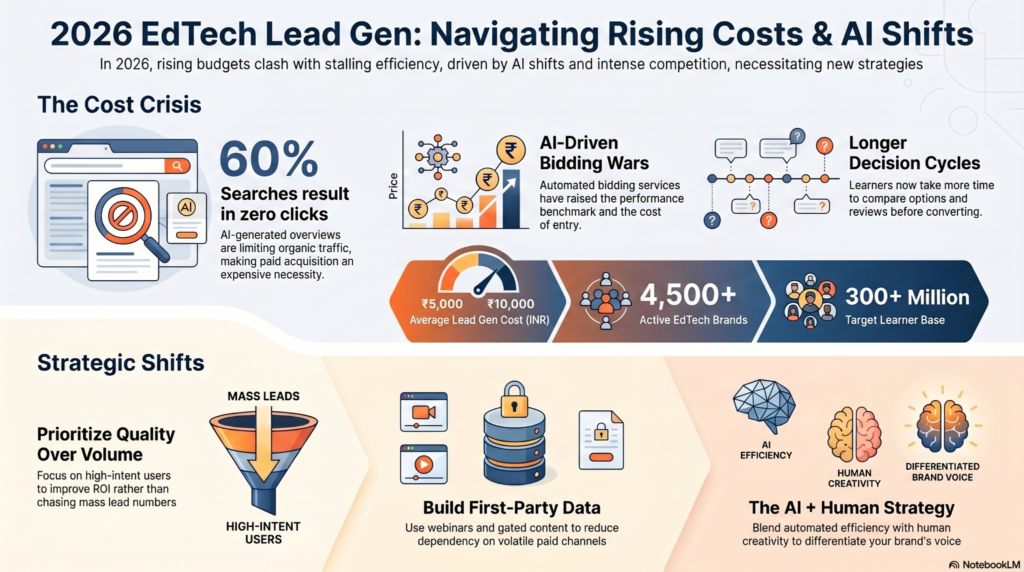
- Based on our experience, lead-gen costs in EdTech are increasing and can reach 5-10K this year.
- Massive competition in India, with 4500+ EdTech brands serving 300+ million learners, is driving up costs.
- EdTech in 2026 is powered by AI, real-time data, and more, which is somewhat levelling the competitive playing field.
- 94% of students use YouTube, while WhatsApp and Google also dominate their usage.
- 60% of the online searches in India result in zero clicks due to AI answers.
Why Education Lead Generation Costs Are Rising?
Below, we have listed the top 6 factors behind the massive increase in EdTech lead gen that are hampering your business growth in 2026.
1. Platform Saturation
The surge in EdTech providers has intensified competition, making EdTech lead generation more expensive across paid channels.
2. AI-Driven Bidding Wars
Automation has improved performance but increased costs. Brands using advanced AI marketing services are raising the benchmark for everyone.
3. Longer Decision Cycles
Today’s learners compare options, read reviews, and take time, resulting in higher acquisition costs in the education sector lead generation.
4. Privacy & Data Limitations
Reduced access to third-party data has made targeting less precise, leading to higher spend on educational advertising.
5. Reduced Organic Visibility
Search behaviour is shifting. AI-generated answers are limiting clicks, making paid acquisition more necessary, even while engaging the top education marketing agencies.
6. Content Saturation
With more brands creating content, differentiation is harder, leading to increased spend for visibility in education lead generation. In other words, the education marketing strategy needs a revamp to target users and AIs holistically.
EdTech Lead Generation in 2026
What EdTech Leaders Must Do Next?
By following these 5 steps, EdTech brands and stakeholders can ensure their online presence reduces lead-gen costs.
1. Prioritize Lead Quality
Focus on high-intent users instead of volume to improve ROI.
2. Build First-Party Data (h4)
Leverage webinars, gated content, and communities to reduce reliance on paid channels.
3. Use Full-Funnel Strategies
Combine awareness, retargeting, and nurturing. Strong digital marketing services play a key role here.
4. Combine AI with Human Strategy
The future lies in blending automation with human creativity for effective education lead generation.
5. Optimize for AI Search
Structure content to rank in AI Overviews and intent-driven SERPs. All of this and more is possible if you have a competent digital marketing partner…
How Wildnet Technologies Can Help Your EdTech Business in India?
Wildnet Technologies blends performance-driven education marketing with advanced AI marketing services to optimize the education lead generation. From high-converting funnels to end-to-end digital marketing services, we help EdTech brands reduce CAC (client acquisition cost), improve lead quality, and scale sustainably in India’s competitive online education ecosystem.
Conclusion
Education lead generation in 2026 is no longer about spending more; it’s about spending smarter. Rising costs are driven by competition, AI-driven platforms, and changing user behaviour. But they also create opportunities for brands that adapt quickly.
The future belongs to those who balance data with creativity, automation with human insight, and scale with efficiency. Want to capture edtech’s future in India?
Wildnet Technologies Ltd is here to help out with its AI + Human EdTech marketing services in India.
Wish to know more?
> EdTech Social Media Marketing Trends You Can’t Ignore in 2026
> Digital Marketing Strategy for EdTech: A Complete Guide for 2026
> Why EdTech Growth Breaks & Marketing in Education Fixes It?
Connect with us at info[@]wildnettechnologies.com and get leads at lower prices in the long term.
FAQs
Question 1: Why is Education Lead Generation becoming more expensive?
Answer 1: Due to increased competition, AI-driven ad auctions, and reduced organic visibility, edtech lead generation costs are through the roof.
Question 2: How can EdTech brands reduce lead generation costs?
Answer 2: By improving conversion rates, leveraging first-party data, and using full-funnel strategies, while focusing more on brand building, so that fewer paid ads are needed.
Question 3: Are AI marketing services necessary in 2026?
Answer 3: Yes, they enhance targeting and efficiency, but should be paired with a human strategy to stay relevant to the readers.
Question 4: What channels work best for Education Lead Generation?
Answer 4: A mix of paid ads, SEO, SMM, and nurturing channels like email works best.
Question 5: How does AI impact education marketing?
Answer 5: AI affects bidding, personalization, and search visibility, reshaping how leads are generated.