
Key Takeaways
- SEO principles are not arbitrary rules; they reflect how search engines evaluate relevance, credibility, and value, and violating them consistently means lower rankings regardless of content quality
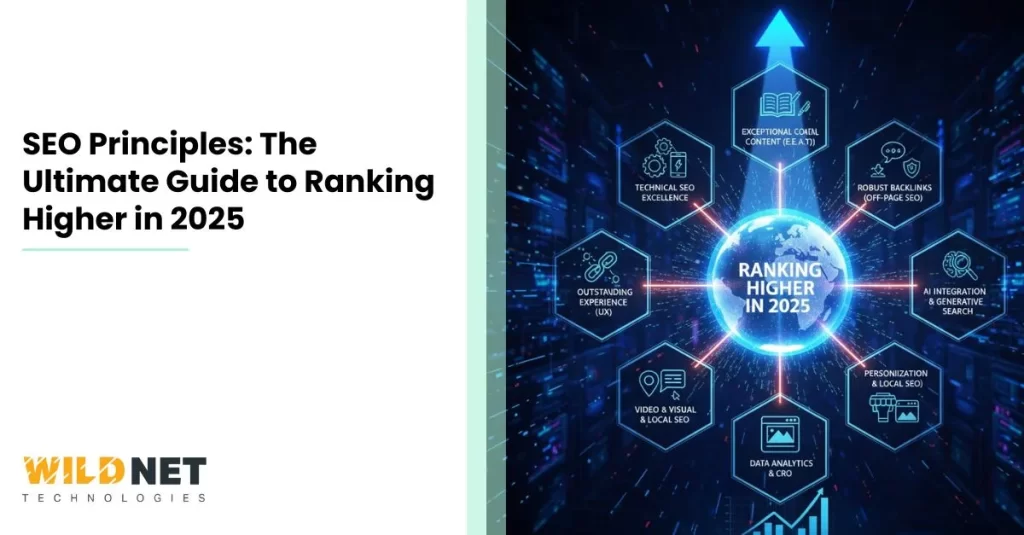
- Core SEO principles span five interconnected areas: keyword strategy, on-page optimisation, technical health, link authority, and user experience, all of which reinforce each other
- On-page and technical SEO principles together determine whether strong content can rank at its potential or gets suppressed by invisible infrastructure problems
- SEO best practices require continuous iteration, not one-time implementation; algorithm updates, competitor movement, and content decay all demand regular review
- SEO principles for rankings in 2026 increasingly reward topical authority, content depth, and genuine user engagement over keyword density and link volume alone
Introduction
Every business investing in organic search eventually hits the same wall.
Traffic plateaus. Rankings stall. Content that seemed strong stops performing. The instinct is usually to produce more content or chase more backlinks.
The real problem is almost always foundational. SEO principles are not being applied systematically. One pillar is strong while others are ignored. Keyword strategy is solid but technical health is broken. Content quality is high but authority signals are thin. The system only works when its components work together.
This guide covers the complete framework.
What SEO Principles Actually Are
SEO principles are the foundational guidelines that determine whether search engines can find, understand, trust, and rank your website above competitors.
They are built around three questions Google asks about every page it evaluates. Is this content relevant to what the user searched for? Is the website credible enough to trust? Is the experience good enough to recommend? Every SEO best practice traces back to one of those three questions.
Businesses that follow core SEO principles consistently build compounding organic visibility. Those that ignore them spend money on content and links that produce diminishing returns because the foundation is not supporting the investment.
Core SEO Principles Every Website Must Follow
1. Keyword Research and Search Intent
Keywords are how users communicate their needs to search engines. Understanding not just what people search for but why they search for it separates effective SEO from keyword stuffing.
Map keywords by intent. Informational queries belong on blog and educational content. Transactional queries belong on product and service pages. Navigational queries signal branded awareness. A page optimised for the wrong intent will consistently underperform regardless of keyword inclusion frequency.
Long-tail keywords with specific intent and lower competition provide faster ranking opportunities, particularly for newer domains building authority.
2. On-Page and Technical SEO Principles
On-page and technical SEO principles operate as a pair. On-page covers the visible content layer: unique title tags with the primary keyword in the first 60 characters, meta descriptions around 155 characters that improve CTR, logical H1 and H2 heading structure, internal links connecting related pages, and body content that genuinely answers the user’s query.
Technical SEO covers the infrastructure: mobile-first responsiveness, Core Web Vitals scores for loading speed and visual stability, HTTPS security, XML sitemaps that guide crawlers, canonical tags that prevent duplicate content from diluting ranking signals, and clean URL structures without unnecessary parameters.
A page that scores well on content but poorly on technical health will be held back. A technically perfect page with thin content will not rank. Both must be addressed simultaneously for either to perform at full potential.
3. Content Quality and Topical Authority
Search engines in 2026 evaluate content against E-E-A-T: Experience, Expertise, Authoritativeness, and Trustworthiness. Content written by credible authors, backed by original insight, and structured to genuinely serve the reader outperforms content written primarily to rank.
Content clusters amplify this. Instead of isolated blog posts targeting random keywords, building content around a central pillar page with interconnected supporting articles builds topical authority across an entire subject area. Google rewards sites that demonstrate deep, consistent expertise in a niche over sites with scattered, shallow coverage.
Update existing content regularly. A page that ranked well two years ago with outdated statistics and stale examples gradually loses visibility as fresher, more accurate content overtakes it.
4. Link Building and Domain Authority
Backlinks remain one of the strongest SEO ranking signals. Every quality external link to your site functions as an editorial endorsement that increases domain authority and helps individual pages compete for competitive keywords.
SEO best practices for link building prioritise quality over volume. One contextual link from a respected industry publication produces more ranking impact than fifty links from unrelated directories. Guest publishing, digital PR, original research, and broken link outreach are the methods that consistently produce high-quality backlinks without penalty risk.
Monitor your backlink profile monthly. Toxic links from penalised or irrelevant domains can suppress rankings if left unaddressed.
5. User Experience as a Ranking Signal
Google uses behavioral signals to evaluate whether a page delivered on its promise. If users click a search result, immediately return to the SERP, and click a different result, that pattern tells the algorithm the first page failed to satisfy the query.
SEO principles for rankings therefore extend into UX: intuitive navigation, readable content structure with short paragraphs and clear headings, fast load times that do not frustrate mobile users, and clear calls to action that guide users toward the next logical step. Dwell time, pages per session, and return visit rate are all indirect signals of content quality that influence ranking behavior.
Advanced SEO Principles Worth Implementing in 2026
Voice search optimisation
Voice queries are longer and conversational. Structuring FAQ sections and content around natural language questions positions pages as candidates for voice responses and AI Overview citations.
Core Web Vitals
LCP, CLS, and FID are live ranking signals. Consistently passing Core Web Vitals thresholds provides a structural advantage that compounds across every page on the site.
Local SEO
Businesses serving specific geographies need location-specific keyword optimisation, a complete and actively managed Google Business Profile, consistent NAP data across citations, and genuine customer reviews that build local trust signals.
Measuring and Iterating SEO Performance
SEO principles applied once and forgotten produce diminishing returns.
Use Google Search Console for keyword impressions, CTR, and crawl coverage. Use Google Analytics for organic traffic behavior, session depth, and conversion attribution. Use Ahrefs or SEMrush for keyword ranking movement, backlink monitoring, and competitor gap analysis.
Run a full technical audit quarterly. Update underperforming content with fresher data, improved structure, and better internal linking. React to algorithm updates by checking which page types were most affected and adjusting strategy accordingly. SEO best practices are not static; they evolve as search engine evaluation models become more sophisticated.
Conclusion
SEO principles are the framework that determines whether every other SEO investment produces results or goes to waste.
The businesses that dominate organic search in their niche are not the ones that occasionally apply SEO tactics. They are the ones that treat SEO principles as operational standards applied consistently across every page, every piece of content, and every technical decision.
Over 20 years, Wildnet Technologies has grown from a digital marketing firm into a full-stack, AI-native growth partner with 350+ in-house experts, 2,100+ projects delivered globally, and a track record of turning brands into market leaders. We don’t just run campaigns; we build digital ecosystems.
Ready to grow? Here’s how we can help:
SEO Services: We go beyond rankings. Our SEO strategies combine technical precision, AI-driven insights, and content authority to put your brand in front of the right audience at the right moment consistently.
Technical SEO Services: From Core Web Vitals to crawl architecture and schema implementation, we fix the technical issues that quietly prevent strong content from ranking where it should.
Digital Marketing Services: From awareness to conversion, we build full-funnel digital strategies tailored to your industry, audience, and growth stage so every rupee you spend works harder.
Great digital marketing doesn’t cost you money — it makes you money.
FAQS
1. What are SEO principles and why do they matter?
SEO principles are the foundational best practices that help search engines find, understand, and rank your website. Following them consistently produces sustainable organic visibility and long-term traffic growth.
2. What are the core SEO principles every website needs?
Keyword research, on-page and technical SEO, content quality, link building, and user experience. All five work together; weakness in any one area limits the effectiveness of the others.
3. How do on-page and technical SEO principles differ?
On-page SEO covers visible content elements like titles, headings, and internal links. Technical SEO covers infrastructure like site speed, mobile-first indexing, and crawlability.
4. How often should SEO best practices be reviewed?
Continuously monitor performance and run full audits quarterly, or immediately after any major Google algorithm update affects your traffic.
5. Do SEO principles for rankings change with algorithm updates?
The fundamentals remain stable: relevance, authority, and user experience. What evolves is how search engines measure and weigh each signal.
Read More
- AI Search SEO Services: Your Complete Guide to AI Visibility in 2026
- Google March 2026 Core Update: The Rise of Experience-Led SEO
- SEO Services for AI-powered discovery: Why Your Business Needs Them Now
- SEO Services for AI-driven platforms: Future-Proof Your Brand Visibility