
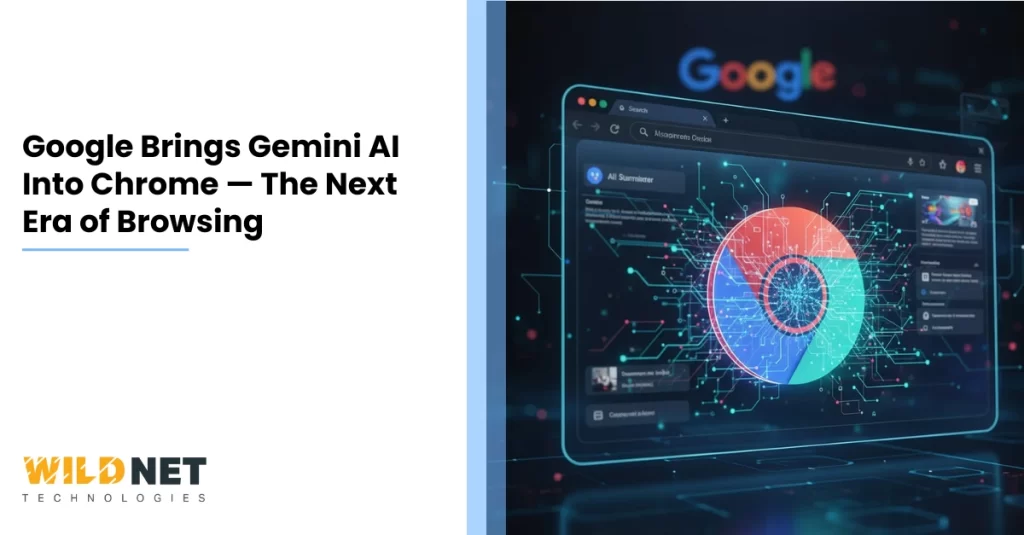
Recently, Google made a significant announcement related to AI mode: it’s integrating its Gemini AI model directly into the Chrome browser to transform how we browse, search, and interact online. The move signals a shift from passive web browsing toward a more intelligent, assistant-driven experience.
Below is a breakdown of what it means in practice and how this change could reshape the browser landscape.
Key Announcements & Highlights
1. “Our next Chrome era is just beginning…”
- Sundar Pichai, Google CEO, described the integration of Gemini into Chrome as the dawn of a new “Chrome era.”
- He emphasized that the goal is to make Chrome safer, smarter, and more helpful, while preserving speed and security.
- With Gemini in Chrome, users can expect context-aware assistance: understanding web pages, navigating across tabs, scheduling, and more intelligent search.
- The rollout will start on Windows, macOS, and mobile (U.S. first) before wider distribution.
2. “Google Chrome Gets 10 New AI Features with Gemini Integration”
• A Gemini Assistant Button that opens a side panel to ask questions or get summaries.
• Smart summarization across tabs — Gemini can collate info from multiple open pages.
• AI in the omnibox (address bar), allowing you to ask complex queries directly and get contextual answers.
• Recall of past pages without scrolling through history — ask Gemini to fetch something you read earlier.
• Visual search, security alerts, smarter autofill, and task management embedded into browsing.
3. “Chrome: The browser you love, reimagined with AI”
- Google frames this update as a set of new features and a redefinition of browsing.
- Gemini in Chrome will act as an intelligent assistant that understands context across tabs, answers questions, and links with Google tools like Docs, Calendar, etc. blog.google
- The Omnibox is being upgraded with AI Mode. In AI Mode, you can type natural language or multi-step questions and get richer, context-aware results.
- AI will also play a stronger role in privacy and security, detecting phishing, managing passwords, supervising risky sites, and simplifying privacy decisions.
- With English support, the rollout will begin in the U.S., but expansion to more countries and languages is expected soon.
Implications & What to Watch Out For
What this means for users / everyday browsing
- Browsing becomes more proactive: instead of switching tabs and doing manual searches, Gemini can assist in the flow of work.
- Better information summarization will save users’ time, especially when dealing with multiple open articles, research sessions, or long reports.
- The new omnibox AI Mode could make Chrome more like a conversational search tool than a regular browser.
- Enhanced security features built with AI could help reduce exposure to phishing and malicious sites.
Challenges & caveats
- Currently, the rollout is geographically limited (U.S. first) and in English; global users must wait.
- Integration with Gemini could raise privacy concerns: how much of your browsing data is processed, stored, or used to improve models?
- The assistant features will need to be highly accurate. Mistakes in answer, summarization, or context could reduce user trust.
- Competing browsers or search providers may intensify efforts to integrate their AI agents to maintain relevance.
- Developer and web compatibility implications: how will existing web apps or extensions interact with AI overlays?
Summary & Final Thoughts
Google’s decision to embed Gemini AI within Chrome marks a bold step in the browser’s evolution from a display and navigation tool to an intelligent assistant embedded in our web experience. The new capabilities, AI summarization across tabs, conversational queries in the omnibox, context-aware features, and enhanced security, reflect Google’s ambition to make browsing more intuitive and productive.
However, success will depend heavily on trust, precision, and global rollout. For digital experience stakeholders, it’s a signal that the browser is becoming a frontline battleground for AI innovation.
As a Digital marketing services provider, we closely monitor these shifts to guide clients in optimizing content, UX, and strategy for this new AI-powered web era.
Read More
Safari Vs Chrome Which Is Better?
Third-Party Cookies Are Not Going Away: Here’s What Google’s New Plan for Chrome Means
What is Reverse Video Search and How to Do It?
What are Google AI Mode Ads? An Easy Guide to the Future of Ads