

Summary
Achieving product-market fit (PMF) is one of the biggest milestones for any SaaS company. But for many brands, growth starts slowing down immediately after reaching it. Why? Because scaling requires a completely different approach than validation.
This blog explores the 7 biggest SaaS Marketing mistakes that prevent SaaS brands from scaling after PMF. From poor positioning to weak onboarding and overdependence on paid ads, we break down what stops momentum & how modern SaaS brands can build sustainable growth in 2026.
Key Takeaways
- Product-market fit does not guarantee scalable growth.
- Many SaaS companies fail because they scale acquisition before fixing retention.
- Modern SaaS Marketing requires strong positioning, onboarding, AI-driven personalization, and content authority.
- A balanced growth engine combines organic, paid, product-led, and community-driven marketing.
- SaaS companies that invest in long-term trust and user education outperform short-term acquisition-focused competitors.
Table of Contents
- A Few Facts about SaaS Marketing
- 7 SaaS Marketing Mistakes That Stop Growth After Product-Market Fit
- Quick SaaS Marketing Audit Checklist
- How Wildnet Technologies Empowers Its Clients with SaaS Marketing?
- Conclusion
- FAQs
Most SaaS companies think product-market fit guarantees scale. In reality, it often signals stalled growth.
The biggest reason? Weak SaaS marketing systems that fail under scale pressure. The strategies that help a company achieve PMF are not the same strategies that help it scale from early traction to sustainable revenue growth.
In 2026, the SaaS landscape is more competitive than ever. AI-generated products are flooding the market, customer acquisition costs are rising, and buyers expect faster onboarding, hyper-personalization, & educational buying experiences.
This is where modern SaaS marketing becomes critical. Brands that fail to evolve their growth engine after PMF often struggle with:
- Rising churn
- Weak differentiation
- Inefficient CAC
- Poor onboarding experiences
- Overdependence on paid acquisition
- Stagnant SaaS growth
Let’s explore the seven biggest mistakes that stop SaaS companies from scaling effectively.
A Few Facts about SaaS Marketing
- Based on our experience working in the SaaS niche, the CAC now ranges from INR 50-70k or USD 600-850.
- In 2026, customer retention is more important than website traffic.
- 60% of searches don’t result in a click because of AI-generated summaries.
- Thought leadership content has led to 54% more sales, 53% more business and 42% new opportunities.
- Educational content has driven a 131% increase in conversions.
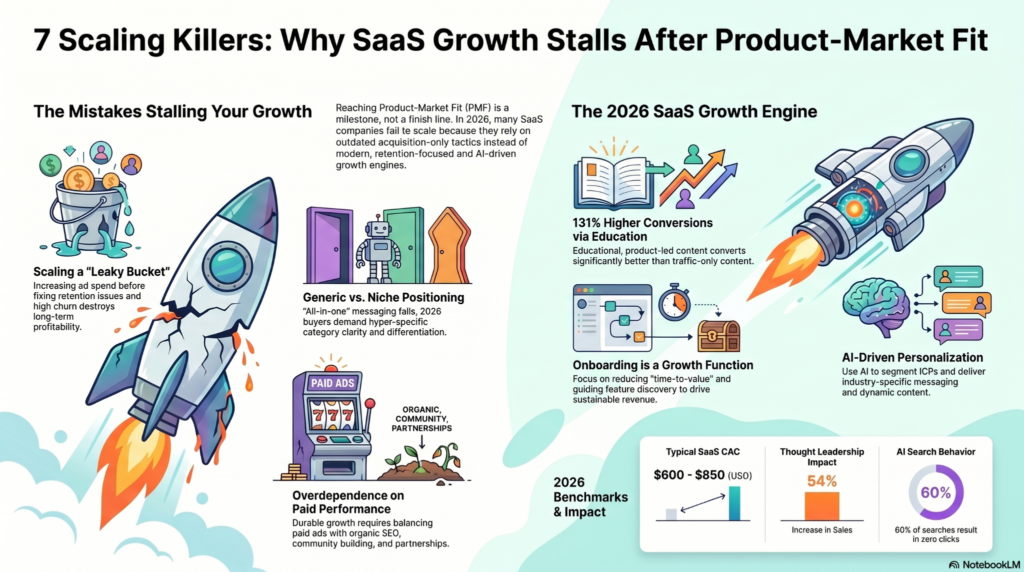
7 SaaS Marketing Mistakes that halt growth after PMF stage
7 SaaS Marketing Mistakes That Stop Growth After Product-Market Fit
Below are the seven issues that are preventing your SaaS company from growing beyond the PMF stage.
1. Scaling Paid Ads Before Fixing Retention
One of the biggest SaaS marketing mistakes is increasing ad spend while retention issues still exist. Many SaaS brands try to scale aggressively after PMF by investing heavily in Google Ads, LinkedIn Ads, and performance campaigns. But if users are churning quickly, growth becomes unsustainable.
A leaky bucket destroys profitability. Before scaling acquisition, a SaaS brand must:
- Improve onboarding flows
- Reduce time-to-value
- Optimize activation milestones
- Build lifecycle email journeys
- Analyze churn reasons
- Improve SaaS customer retention
The smartest SaaS brands treat retention as growth.
2. Weak Positioning in a Crowded Market
In 2026, “all-in-one platform” messaging no longer works. Most SaaS categories are overcrowded. If your messaging sounds generic, buyers will ignore you.
Strong SaaS marketing depends on category clarity. Your positioning should instantly answer:
- Who is this for?
- What problem does it solve?
- Why is it different?
- Why now?
A focused niche message often outperforms broad messaging. This is why many brands now work with a specialized B2B SaaS marketing agency, like Wildnet, that understands category positioning deeply.
3. Ignoring Product-Led Content
Many SaaS brands create content only for traffic. But traffic without product alignment rarely converts. That’s why modern SaaS marketing strategy relies heavily on product-led growth and educational content, such as:
- Workflow tutorials
- Use-case breakdowns
- Integration guides
- AI implementation examples
- Industry-specific playbooks
- SaaS funnel education
The goal is not just visibility. The goal is to help users imagine success with your product. High-quality educational content also improves visibility across Google SERP, AI Overviews, and ChatGPT recommendations.
4. Depending Entirely on Performance Marketing
Paid advertising can accelerate growth, but overdependence creates risk. If your pipeline disappears the moment ad spend stops, your business lacks a durable growth engine.
Thus, strong SaaS marketing balances:
- SEO,
- Community building,
- Partnerships,
- Thought leadership,
- Organic social,
- Referral loops, and
- Product-led acquisition.
The best SaaS brands create brand familiarity before buyers even enter the funnel. This is where a strategic marketing agency for SaaS can help diversify growth channels effectively.
5. Treating Every ICP the Same
Not every customer buys for the same reason. A startup founder, an enterprise buyer, and an operations manager have completely different priorities. Yet many SaaS companies use the same messaging for all audiences.
Modern SaaS marketing requires segmentation via:
- Personalized landing pages
- Industry-specific messaging
- Intent-based nurture sequences
- AI-driven recommendations
- Different onboarding journeys
The more relevant the experience feels, the higher the conversion rate. This is also why personalized SaaS marketing services are becoming essential for scaling companies.
6. Neglecting Onboarding & User Education
Acquisition gets attention. Onboarding drives revenue. Many SaaS products lose users because customers never fully understand the platform’s value.
Effective onboarding should:
- Deliver quick wins
- Reduce complexity
- Guide feature discovery
- Encourage habit formation
- Show measurable outcomes
- Improve onboarding experience
The best SaaS marketing teams work closely with product & customer success teams to continuously improve activation metrics. In 2026, onboarding is no longer just a product function. It is a core growth strategy.
7. Underestimating AI-Driven Marketing
AI is rapidly reshaping the SaaS industry. Companies that still rely on outdated marketing workflows are losing speed, personalization, and efficiency advantages.
Modern SaaS AI marketing services help brands:
- Personalize campaigns at scale
- Predict churn behaviour
- Improve lead scoring
- Generate dynamic content
- Optimize funnel journeys
- Analyze user intent faster
However, the winning formula is not “AI-only.” The future belongs to brands combining AI efficiency with human creativity and strategic thinking. This combination creates scalable and trustworthy growth.
Quick SaaS Marketing Audit Checklist
Before scaling your SaaS business, ask these questions:
- Is retention stronger than acquisition?
- Does onboarding reduce time-to-value?
- Is your positioning niche-specific?
- Are you overly dependent on paid ads?
- Does your content educate users effectively?
- Is your SaaS funnel optimized for activation?
- Are AI workflows integrated into your marketing systems?
- Are you consistently tracking churn reduction metrics?
If the answer to multiple questions is “no,” your growth may stall after PMF. Worry not, because we are here to help.
How Wildnet Technologies Empowers Its Clients with SaaS Marketing?
At Wildnet, we help SaaS brands move beyond vanity metrics and build scalable growth systems.
Our approach combines:
- AI-powered campaign optimization
- Product-led content strategies
- SEO for Google SERP, AI Overviews & ChatGPT
- Conversion-focused onboarding journeys
- Full-funnel performance marketing
- Personalized user acquisition strategies
By blending human creativity with intelligent automation, our team delivers measurable growth that improves visibility, retention, and revenue for SaaS businesses in competitive markets.
Conclusion
Achieving PMF is not the final stage of SaaS growth. It is the beginning of a much more competitive phase. The companies that will scale successfully in 2026 are those that evolve their SaaS marketing beyond acquisition alone.
Retention, positioning, onboarding, personalization, and educational content now play a much larger role in sustainable growth. Because the market is crowded, buyer attention is shrinking, and AI is changing how users discover products.
SaaS brands that adapt early will dominate category conversations across search engines, AI assistants, and digital communities. The ones that do not will struggle to maintain momentum even after finding product-market fit.
Wildnet Technologies Ltd is a well-known SaaS Marketing Agency helping brands in India grow in the AI age.
Wish to know more?
> Personalization-as-a-Service: A new SaaS Business model
> 5 SaaS Growth Marketing Case Studies to Inspire Your 2026 Playbook
> SEO Marketing for SaaS Companies: Turn Search Into Pipeline
Connect with us at info[@]wildnettechnologies.com and make the most after you hit the PMF milestone.
FAQs
Question 1: What is the biggest SaaS marketing mistake after product-market fit?
Answer 1: The biggest mistake is scaling acquisition before improving retention and onboarding. If users churn quickly, paid growth becomes unsustainable.
Question 2: Why is content important in SaaS marketing?
Answer 2: Strong SaaS content marketing builds authority, improves organic visibility, educates buyers, and increases trust. It also helps brands appear in Google AI Overviews, AI Mode, and ChatGPT recommendations.
Question 3: How does AI impact SaaS marketing in 2026?
Answer 3: AI improves personalization, campaign optimization, lead scoring, and user journey automation. However, human strategy and creativity still remain essential.
Question 4: Should SaaS companies focus only on paid ads?
Answer 4: No. Sustainable SaaS growth comes from balancing paid ads with SEO, community building, partnerships, and product-led growth channels.
Question 5: What makes a successful SaaS marketing strategy?
Answer 5: A successful SaaS marketing strategy combines:
- Clear positioning
- Strong onboarding
- Product-led content
- Retention optimization
- Personalized experiences
- Multi-channel acquisition
- AI-assisted decision-making