
Summary
This case study explores how the Udemy marketing strategy helped them scale into a global learning powerhouse without relying on aggressive advertising. By blending creator-led growth, data intelligence, and AI-powered personalization, Udemy built trust, relevance & repeat usage at scale.
The insights uncovered here are especially valuable for EdTech brands and for businesses partnering with agencies like Wildnet that combine human strategy with AI-driven execution for sustainable growth.
Introduction
In a world flooded with online courses, Udemy didn’t win by shouting the loudest. It won by listening better. The Udemy marketing strategy focuses less on flashy campaigns & more on building a self-sustaining ecosystem where learners, instructors, and technology reinforce each other.
What makes the marketing strategy of Udemy fascinating is its balance, human creativity on one side, and algorithmic intelligence on the other. This blend is exactly why Udemy scaled globally without burning trust or budgets.
Udemy Marketing Strategy
At its core, the Udemy marketing strategy is platform-led, data-informed, and instructor-powered. Instead of positioning itself as a traditional EdTech brand, Udemy behaves like a marketplace, by using demand signals, learner behaviour, and content performance to guide growth.
Unlike a typical eCommerce marketing strategy Udemy doesn’t push products aggressively. It surfaces the right course to the right learner at the right moment, often automatically. This subtlety is why many users feel Udemy “just understands” what they want to learn next.
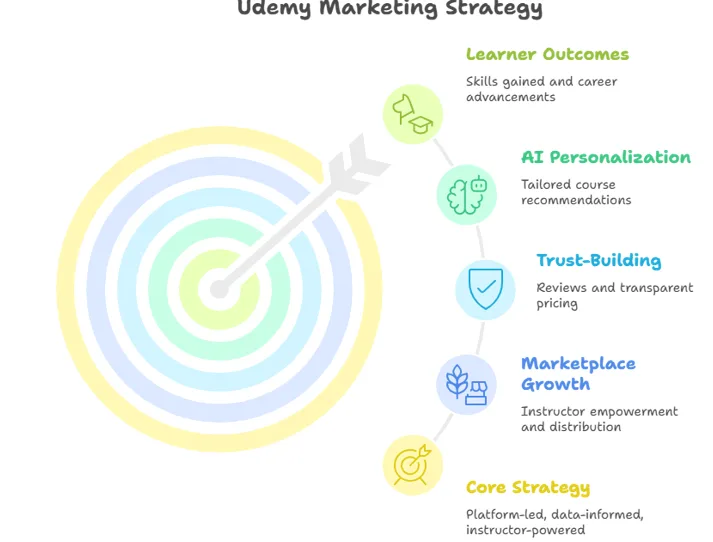
The Udemy Marketing Strategy that helps them Win.
Here are the highlights:
Marketplace-Led Growth
Udemy scales by empowering instructors as creators and distributors, reducing reliance on heavy advertising.
Trust-First Marketing
Reviews, ratings, previews, and transparent pricing build learner confidence & drive conversions.
AI-Powered Personalization
Course discovery, emails, and recommendations are optimized using AI to match learner intent & behaviour.
Outcome-Driven Messaging
Udemy focuses on skills gained and career outcomes rather than just course features.
Human + AI Execution
Strategic decisions are human-led, while AI scales relevance, timing, and personalization across touchpoints.
Business Overview
Founded in 2010, Udemy operates as a two-sided marketplace connecting millions of learners with instructors across the globe. Its revenue comes from individual course purchases, subscriptions (Udemy Business), and enterprise learning solutions.
The marketing strategy Udemy follows is deeply intertwined with its business model. Growth is not driven by one-off campaigns but by long-term value creation, be it content quality, instructor incentives, learner retention, or global reach. Even the Udemy marketing strategy free elements, such as organic discovery and instructor-led promotion, play a critical role in scaling efficiently.
Challenges Faced
The challenges faced by Udemy were magnified by the fact that they operated in global and local markets.
1. Oversaturated EdTech Market
With thousands of competitors offering similar courses, standing out using traditional digital marketing services was increasingly difficult.
2. Trust Deficit Among Learners
Online learners are sceptical. Convincing users that a course will deliver real outcomes was a major hurdle.
3. Instructor Acquisition & Retention
Instructors had choices. Udemy needed to market itself to the creators as much as to learners.
4. Global Audience, Local Preferences
Scaling across countries meant dealing with different languages, pricing sensitivities, and learning behaviours.
5. Attribution Complexity
Multiple touchpoints, such as email, search, app, and referrals, made it hard to measure what truly drove conversions.
Solutions
But their marketing team did not lose hope and solved each problem one by one.
1. Marketplace-Led Positioning
The Udemy marketing strategy leaned into its marketplace identity, allowing instructors to act as micro-marketers while Udemy amplified what worked.
2. Reviews, Ratings & Social Proof
Trust was built through transparent reviews, previews, and outcomes, reducing dependence on aggressive ads.
3. Data-Driven Instructor Enablement
Udemy educated instructors on promotion, pricing, and content optimization, helping them turn into growth partners.
4. AI-Powered Personalization
Using AI marketing services, Udemy personalized recommendations, emails, and app notifications at scale.
5. Performance Marketing with Guardrails
Paid campaigns were optimized using behaviour data and not vanity metrics to keep the CAC, or customer acquisition cost, under control.
Udemy Marketing Strategy 2025: Lessons for Brands & Marketers
The Udemy marketing strategy proves that modern growth is not about more tools, but smarter orchestration. Brands in any niche, and not just EdTech, can borrow these principles.
Best Practices
With the below best practices, any brand can improve its standing in the market for 2026.
- Build ecosystems, not campaigns
- Combine creator-led growth with platform amplification
- Use AI to enhance relevance, not replace humans
- Treat trust as a performance metric
The Marketing Strategy of Udemy shows that when human intent meets machine intelligence, scaling becomes sustainable.
Common Mistakes to Avoid & Their Solutions
These are the common mistakes to avoid and their solutions when it comes to marketing a business in 2025 & beyond.
- Mistake: Over-reliance on paid ads
Solution: Invest in organic loops and content-led discovery
- Mistake: Ignoring creators or partners
Solution: Turn them into distribution channels
- Mistake: Using AI blindly
Solution: Pair AI insights with human judgment
These mistakes occur when digital marketing strategies lack a strategic backbone.
Key Metrics to Track in EdTech Niche
Simply, doing all kinds of marketing won’t deliver results because marketing campaigns need real-time optimization, which occurs once the right KPIs are being tracked.
- Learner Lifetime Value (LTV)
- Course Completion Rates
- Instructor Retention
- Repeat Purchase Frequency
- Personalized Recommendation CTR
Tracking these metrics keeps the marketing strategy of Udemy outcome-focused rather than activity-driven.
AI Marketing Tools that Can Be Used in the EdTech Sector
Don’t get confused in the maze of AI tools in the market. Your Edtech brand can leverage the following,
- Recommendation Engines (behaviour-based) -> Dynamic Yield & Algolia Recommend
- Predictive Analytics (for churn & upsell) -> Microsoft Azure ML & H2O.ai
- AI-powered Email & Notification Tools -> Braze & HubSpot (Motion.ai)
- Content Performance Scoring Systems -> ContentSquare & Atomic Reach
If used correctly, AI marketing services don’t replace marketers; they multiply their impact.
Conclusion
The Udemy marketing strategy didn’t win by being loud. It won by being relevant, trustworthy, and intelligently automated.
Its success reinforces a crucial truth: the future of marketing lies in Human + AI collaboration. At Wildnet Technologies Ltd, this philosophy is core to how we deliver results, whether it’s EdTech or any other niche. We blend strategic thinking, creative intuition, and AI-powered execution to build marketing systems that scale quietly, just like Udemy.