Key Stats:
Ultimate Content Marketing Funnel for Businesses | eBook
The 360-degree Guide to Awesome
Content Creation
1. Introduction
Wondering what is content marketing funnel? Well, a content marketing funnel is a strategic framework that guides potential customers through a journey—from discovering your brand to becoming loyal advocates. It’s built around content that educates, engages, and converts at every stage: awareness, consideration, and decision. In today’s overcrowded digital landscape, publishing content without a plan leads to wasted time and missed opportunities. Businesses need structured & goal-driven content that aligns with the buyer’s journey to attract qualified leads, nurture trust, and drive measurable growth.
While traditional funnels depict a linear path, the modern buyer’s journey is far from straight. That’s where the flywheel model comes in—placing customers at the center and focusing on retention and referrals to keep momentum going. This content funnel eBook merges the best of both worlds, empowering you with a complete & adaptive full funnel content strategy designed to scale your business, optimize conversions, and build long-term brand advocates.
If you are unsure about
- How content relates to marketing funnel,
- How to build an effective content marketing funnel,
- How content marketing impacts your sales funnel, or
- What a tofu mofu bofu content marketing funnel is,
Wildnet’s content funnel ebook is here to help you out.
2. Understanding the Funnel Stages
There are 3 content marketing funnel stages and 1 bonus stage, which makes 4 marketing funnel types.
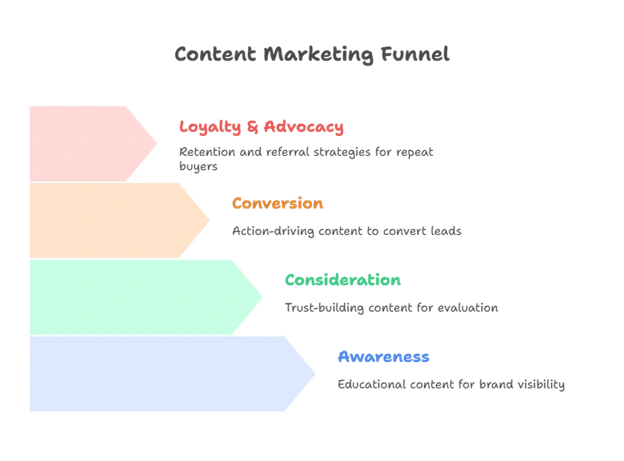
The 4 Types of Content Marketing Funnel
2.1 Top of Funnel (TOFU) – Awareness
At this stage, potential customers are just discovering your brand or realizing they have a problem. The goal here is visibility. Create educational and engaging content such as blogs, social media posts, videos, and SEO-rich articles to capture interest & spark curiosity.
2.2 Middle of Funnel (MOFU) – Consideration
Now that your audience are aware, they’re evaluating their options. This is where trust-building content comes into play—webinars, ebooks, email sequences, and case studies that highlight your expertise & how your solution solves their specific challenges.
2.3 Bottom of Funnel (BOFU) – Conversion
Here, prospects are ready to act. Your content should remove doubts and drive action. Offer product demos, free trials, personalized consultations, testimonials, and strong calls to action (CTAs) to convert leads into paying customers.
2.4 Post-Purchase – Loyalty & Advocacy
Once a customer converts, the journey continues. Focus on retention & referrals through onboarding guides, feedback loops, loyalty programs, exclusive content, and surprise incentives. Happy customers become repeat buyers and powerful brand advocates, fuelling your marketing flywheel.
3. Mapping Your Buyer’s Journey
3.1 Creating Buyer Personas
A strong content marketing funnel starts with knowing who you’re talking to. Buyer personas are fictional representations of your ideal customers, based on real data and market research. Try to include demographics, job roles, goals, challenges, and behaviour patterns as well. This clarity helps personalize your messaging and content strategy.
3.2 Identifying Pain Points & Intent
Understanding your audience’s pain points and what drives their search is key to positioning your content effectively. Ask:
- What problems are they trying to solve?
- What motivates their decisions?
Use surveys, interviews, support queries, and keyword intent analysis to uncover insights that shape relevant content around genuine needs.
3.3 Matching Content to Stages
Once you know your personas and their intent, align content to each stage of the funnel.
For TOFU, focus on educational and SEO-driven content.
For MOFU, offer detailed resources that compare options and demonstrate value.
For BOFU, use trust-building assets like reviews and product demos.
After purchase, deliver content that supports retention and encourages advocacy.
When your content mirrors the customer’s journey, you move from simply publishing to truly connecting while earning trust, guiding decisions, and fuelling growth.
4. Crafting TOFU Content (Awareness Stage)

The 3 Ways to do TOFU
4.1 Blog Posts, Infographics, Videos
At the Top of Funnel (TOFU), your primary goal is to educate, entertain, or inspire—without selling.
Blog posts should address industry trends, how-to topics, or common questions your audience is searching for.
Infographics simplify complex data into visual stories, making them easy to share.
Videos, especially short-form and explainer videos, can boost engagement and establish an emotional connection quickly.
4.2 SEO & Social Strategies
To drive organic discovery, optimize your content with relevant keywords, meta descriptions, and structured data. Focus on search intent and use tools like Google Trends or Semrush for topic ideas. On social media, pair your content with trending hashtags, reels, and carousels to enhance visibility.
TOFU content should prioritize reach over conversion.
4.3 Content Distribution Tips
Even the best content fails without distribution.
Share blog posts in industry forums, Reddit threads, Quora, and relevant Facebook or LinkedIn groups. Repurpose blog content into newsletters, snippets for Twitter, or audiograms for Instagram. Use content syndication platforms or guest posting to tap into existing audiences. The wider your reach, the more brand awareness you build at this early stage.
5. Creating MOFU Content (Consideration Stage)
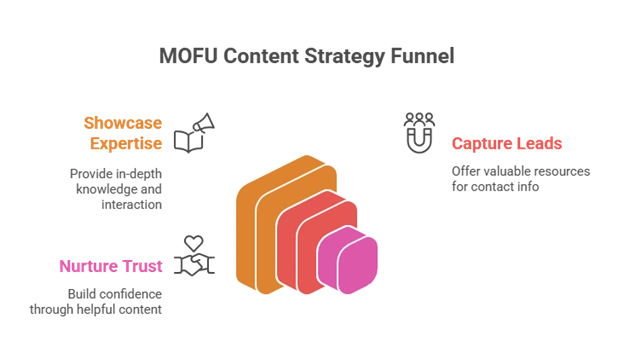
How to do MOFU?
5.1 Ebooks, Webinars, Case Studies
In the Middle of Funnel (MOFU), your audience knows their problem and is evaluating possible solutions. This is your chance to showcase expertise and guide them toward your brand.
Ebooks provide in-depth knowledge and can serve as evergreen resources.
Webinars offer real-time interaction, ideal for demonstrating product value or industry authority.
Case studies show real-world results, providing social proof and building confidence in your offerings.
5.2 Lead Magnets & Email Captures
To continue nurturing prospects, offer valuable lead magnets in exchange for contact information. These can include checklists, whitepapers, templates, or toolkits. Embed email capture forms strategically across landing pages and blog posts. Once acquired, initiate personalized drip email campaigns that deliver value while gently nudging the prospect toward decision-making.
5.3 Building Trust through Value
MOFU content is all about trust. You’re no longer just informing—you’re helping your audience feel confident in your brand. Ensure your tone is helpful, not pushy. Highlight industry knowledge, client results, and unique differentiators. Offer answers, not just features. The more your content addresses their specific concerns and questions, the stronger the emotional and logical case for choosing you becomes. A well-nurtured lead here is far more likely to convert later.
6. Designing BOFU Content (Conversion Stage)
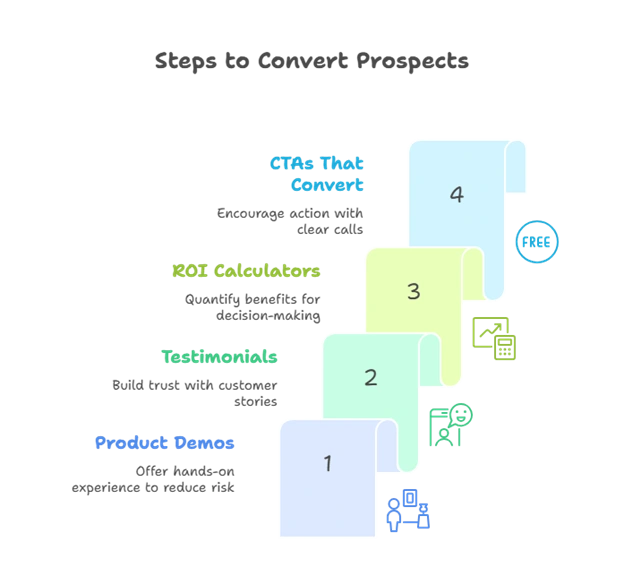
The BOFU Way
6.1 Product Demos, Free Trials, Consultations
At the Bottom of Funnel (BOFU), your audience is primed to make a decision. This is your final opportunity to convince them why your solution is the best fit. Offering product demos, free trials, or one-on-one consultations reduces perceived risk and gives prospects hands-on experience. These touchpoints allow you to address objections directly and tailor your pitch to their specific needs.
6.2 Testimonials, ROI Calculators
Trust is the tipping point. Showcase authentic customer testimonials, success stories, or video reviews that validate your claims. ROI calculators can be powerful decision-making tools—especially in B2B—by quantifying the benefits of your solution and helping prospects justify the investment.
6.3 CTAs That Convert
Your call-to-action (CTA) should be clear, actionable, and value-driven. Use language like “Start Your Free Trial,” “Get a Personalized Demo,” or “Claim Your Offer Now.” Eliminate friction in the process—make forms short, loading times fast, and navigation seamless. At this stage, even minor improvements in experience can significantly boost conversion rates.
7. Retaining & Upselling Customers (Loyalty Stage)
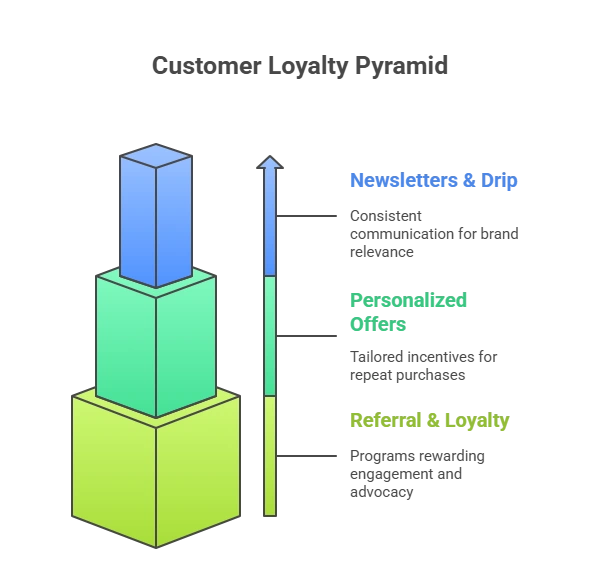
3 Levels of Customer Loyalty Building
7.1 Newsletters & Drip Campaigns
The post-purchase phase is where relationships are deepened. Consistent newsletters and automated drip campaigns help you stay connected with customers. Use these to share helpful content, product usage tips, industry insights, and updates that keep your brand relevant & valuable long after the sale.
7.2 Personalized Offers
Generic marketing won’t cut it in the loyalty stage. Personalized offers—based on purchase behaviour, interests, or milestones—create a sense of exclusivity. Whether it’s a birthday discount, early access to new products, or a customized bundle, these offers drive repeat purchases and boost customer satisfaction.
7.3 Referral & Loyalty Programs
Empower your customers to become brand advocates. Well-structured referral programs incentivize them to bring in new leads, while loyalty programs reward engagement and longevity. Points, discounts, or VIP perks can go a long way in creating emotional loyalty and expanding your reach organically.
8. Content Funnel Tools & Tech Stack
To run a successful sales funnel, you need more than just strategy.
You need the right tools that streamline execution, automate tasks, and measure performance accurately, as detailed in this content marketing PDF.
8.1 CMS, CRM, Email Automation
A robust Content Management System (CMS) like WordPress, Webflow, or HubSpot allows you to publish, manage, and optimize content across your funnel.
Pair this with a Customer Relationship Management (CRM) tool like Salesforce, Zoho, or HubSpot CRM to track every interaction with prospects and personalize communication.
Email automation platforms such as Mailchimp, ActiveCampaign, or Klaviyo enable you to nurture leads with timely and behaviour-based emails that guide them smoothly through the funnel.
8.2 Analytics Tools (GA4, HubSpot)
To refine your strategy, you need data. Google Analytics 4 (GA4) provides deep insight into user behaviour, attribution, and content performance. Tools like Hotjar or Microsoft Clarity help visualize on-page activity, while platforms like HubSpot offer end-to-end funnel analytics with lead scoring and lifecycle tracking. These tools reveal what’s working and what’s not—empowering data-backed decisions.
8.3 Funnel Builders & AI Writers
For fast deployment, use funnel builders like ClickFunnels, Leadpages, or Unbounce to create landing pages and sales flows without coding. To scale content production efficiently, leverage AI writing tools like Jasper, Copy.ai, or ChatGPT for generating blogs, emails, and ad copy tailored to each stage of your funnel.
Together, these tools form the backbone of a high-performing content marketing engine—letting you scale with precision, personalization, and speed.
9. Measuring Funnel Effectiveness
9.1 Key Metrics for Each Funnel Stage
To optimize your content marketing funnel, you must track the right metrics at every stage.
For TOFU, focus on impressions, website traffic, bounce rate, and engagement metrics (likes, shares, time on page).
At MOFU, measure lead generation, email open rates, content downloads, and webinar attendance.
For BOFU, track conversion rates, cost per lead (CPL), and sales-qualified leads (SQLs).
Post-purchase, focus on customer retention rate, repeat purchases, and Net Promoter Score (NPS).
9.2 Attribution Models Explained
Attribution models help determine which touchpoints contribute most to conversions.
First-touch and last-touch models assign credit to the initial or final interaction.
Multi-touch models, like linear or time-decay, distribute credit across several interactions.
Use these models to understand how content across the funnel contributes to customer journeys and ROI.
9.3 A/B Testing & Optimization
Constant testing ensures your funnel stays effective. A/B test subject lines, CTAs, landing pages, content formats, and email sequences. Small tweaks—like button colors or headline phrasing—can yield significant performance gains. Use analytics tools to interpret test results, identify drop-offs, and refine each funnel stage to improve user flow & conversions.
10. B2B vs B2C Content Funnels
While the structure of content funnels is similar in B2B and B2C, the strategies and decision dynamics differ significantly. In B2B funnels, the buying journey is longer, involves multiple decision-makers, and demands high-value & trust-building content like whitepapers, case studies, and webinars. B2C funnels are often shorter & emotionally driven, focusing on visually engaging content, social proof, and compelling CTAs.
Below is a comparison to highlight key differences:
| Aspect | B2B Content Funnel | B2C Content Funnel |
| Decision-making | Rational, multi-step, committee-based | Emotional, quick, individual-based |
| Funnel length | Longer (weeks to months) | Shorter (minutes to days) |
| TOFU Content | Industry blogs, webinars, LinkedIn posts | Social media, influencer videos, blogs |
| MOFU Content | Case studies, whitepapers, and consultations | Product comparisons, reviews, and FAQs |
| BOFU Content | Demos, ROI calculators, and enterprise offers | Discounts, CTAs, urgency messaging |
Example:
A B2B SaaS company might guide leads through a 3-part webinar series before offering a custom demo.
A B2C fashion brand might convert a lead directly from an Instagram ad with a 10% discount.
11. Common Funnel Mistakes to Avoid
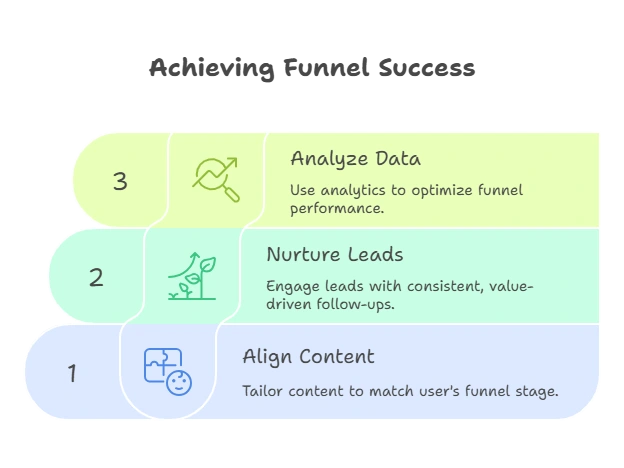
How to achieve Success with your Content Marketing Funnel?
11.1 Misaligned Content
One of the biggest mistakes is creating content that doesn’t match the user’s stage in the funnel. Promoting product demos to someone who’s just learning about your industry can drive them away. Instead, tailor your messaging—educational at TOFU, informative at MOFU, and persuasive at BOFU.
11.2 Skipping Nurturing
Many businesses focus heavily on generating leads but forget to nurture them. Sending one email after a download won’t convert leads into customers. You need consistent and value-driven follow-ups via email sequences, retargeting, or remarketing to build trust and guide users through the funnel.
11.3 Ignoring Data
Without tracking performance, you’re flying blind. Ignoring data means missing out on insights that could dramatically improve conversion rates. Use analytics to identify drop-off points, test content variations, and optimize based on real user behaviour. Data turns assumptions into action—and action into results.
12. Case Studies – High-Performing Content Funnels
12.1 SaaS Funnel Example
A B2B SaaS company offering project management tools used a three-step funnel strategy.
At TOFU, they published SEO-optimized blog posts on productivity tips and remote work culture.
In MOFU, they offered a content funnel ebook titled “The Ultimate Guide to Agile Teams” behind an email gate, followed by a 5-email drip campaign.
BOFU featured a free 14-day trial and a personalized demo request.
Result: A 40% increase in qualified leads and a 22% rise in trial-to-paid conversions.
12.2 eCommerce Funnel Example
A D2C skincare brand created short TikTok videos and influencer reels to drive TOFU awareness.
Their MOFU strategy included user-generated review videos, email newsletters with skincare guides, and an interactive skin quiz.
BOFU offered limited-time discounts and abandoned cart emails.
Result: A 28% uplift in conversions and a 3X return on ad spend (ROAS) from apt funnel content marketing for ecommerce.
12.3 Service-Based Business Funnel Example
A digital marketing agency targeted startups with educational LinkedIn carousels (TOFU), lead magnets like audit templates (MOFU), and BOFU discovery call CTAs. Follow-ups included case studies and testimonials.
Result: A 35% increase in booked consultations and higher-quality leads.
13. Building Your Funnel – Step-by-Step Checklist
Creating an effective content marketing funnel requires clarity, consistency, and commitment.
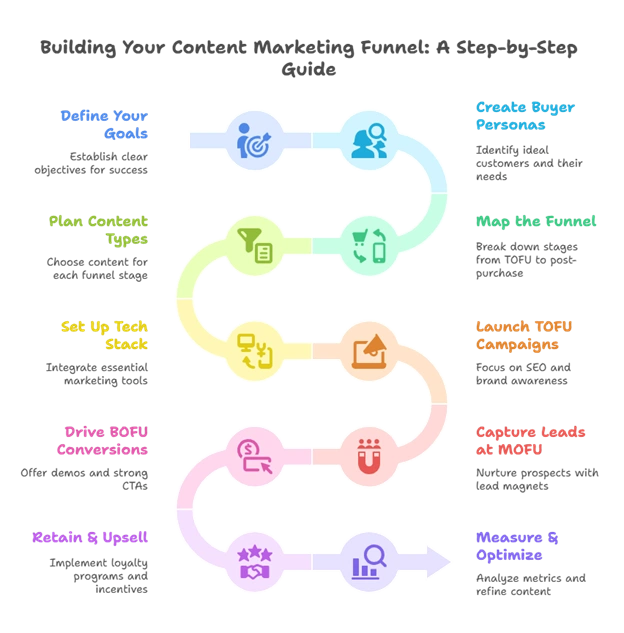
10 Steps to Build a Top-Notch Content Funnel
Here’s a streamlined checklist to guide your implementation:
- Define Your Goals – Decide what success looks like: leads, conversions, or retention.
- Create Buyer Personas – Identify your ideal customers, their pain points, and decision drivers.
- Map the Funnel – Break down TOFU, MOFU, BOFU, and post-purchase stages.
- Plan Content Types – Choose blogs, videos, webinars, ebooks, and CTAs for each stage.
- Set Up Tech Stack – Integrate CMS, CRM, email automation, and analytics tools.
- Launch TOFU Campaigns – Focus on SEO, social media, and brand awareness.
- Capture Leads at MOFU – Use lead magnets and email sequences to nurture prospects.
- Drive BOFU Conversions – Offer demos, discounts, testimonials, and strong CTAs.
- Retain & Upsell – Implement newsletters, loyalty programs, and referral incentives.
- Measure & Optimize – Analyze funnel metrics, run A/B tests, and refine content regularly.
14. The Future of Content Funnels
14.1 AI, Personalization & Predictive Analytics
Content funnels are becoming smarter. With AI, brands can personalize experiences at scale—delivering the right message to the right person at the right time. Predictive analytics enables marketers to anticipate user behaviour & proactively guide prospects through the funnel, increasing efficiency and conversion rates.
14.2 Omnichannel Funnels
The future isn’t just digital—it’s integrated. Omnichannel funnels seamlessly connect email, social media, paid ads, the web, and offline touchpoints. Users expect consistent messaging and smooth transitions, whether they start on Instagram, visit your website, or open your app. Unified funnels will dominate tomorrow’s marketing landscape.
14.3 Voice & Video-First Experiences
As attention spans shrink, voice search and short-form video are reshaping how users consume content. Funnels built around podcast episodes, voice assistants, YouTube Shorts, and Instagram Reels are becoming essential. These formats offer faster engagement, stronger storytelling, and greater emotional impact—fuelling conversions with speed & style.
15. Conclusion
Content marketing isn’t just about creating—it’s about guiding, nurturing, and converting with purpose. Mastering funnel thinking means viewing every piece of content as a step in a larger journey, thoughtfully designed to meet your audience where they are and lead them toward action. It’s about intentionality—knowing the difference between what educates, what persuades, and what converts. But the work doesn’t stop at conversion. The most successful businesses recognize that content is a continuous engine, not a one-time play. With the right strategies, tools, and insights, your content funnel can evolve into the flywheel—spinning growth from trust, loyalty, and advocacy. Whether you’re a startup or an enterprise, consistent content aligned with your funnel will compound results over time.
Stay curious, stay customer-focused, and keep optimizing. In a landscape driven by information, content isn’t just king—it’s the kingdom, the map, and the key to sustainable growth.
16. Appendix
16.1 Glossary
Content Marketing Funnel – A strategic model that maps the customer journey from awareness to conversion using content.
TOFU (Top of Funnel) – The awareness stage focused on attracting and educating new audiences.
MOFU (Middle of Funnel) – The consideration stage where leads are nurtured through informative and value-driven content.
BOFU (Bottom of Funnel) – The decision stage where content is tailored to convert leads into customers.
CRM (Customer Relationship Management) – Software that manages and analyzes customer interactions to improve relationships.
Lead Magnet – Valuable content offered in exchange for a prospect’s contact information.
A/B Testing – The process of comparing two versions of the test subject to determine which performs better.
Attribution Model – A framework for assigning credit to marketing touchpoints that contribute to conversions.
Omnichannel Marketing – A strategy that ensures a consistent brand experience across all customer touchpoints (digital & offline).
16.2 Links for Further Reading
Content Marketing Institute – Funnel Strategies
HubSpot – Ultimate Guide to Content Funnels
Google Analytics 4 Documentation
SEMrush Blog – Content Funnel Optimization
Neil Patel – Understanding Buyer Journeys
About the Author
Wildnet Technologies is a global digital transformation and marketing powerhouse, trusted by over 4,100 clients across 20+ countries. With deep expertise in content marketing, performance media, SEO, full-funnel strategy and AI-driven marketing services, we help businesses build growth-focused digital ecosystems that convert. Our award-winning teams combine creativity with cutting-edge technology—AI, automation, and analytics—to craft personalized & high-performing customer journeys.
Whether you’re a startup looking to scale or an enterprise aiming for global impact, Wildnet’s user content-first approach ensures your brand connects meaningfully at every stage of the funnel.
We don’t just follow trends—we set them.
Learn more at www.wildnettechnologies.com or
Email us at info@wildnettechnologies.com
Table of Content
1. Introduction
2. Understanding the Funnel Stages
2.1 Top of Funnel (TOFU) – Awareness
2.2 Middle of Funnel (MOFU) – Consideration
2.3 Bottom of Funnel (BOFU) – Conversion
2.4 Post-Purchase – Loyalty & Advocacy
3. Mapping Your Buyer’s Journey
3.1 Creating Buyer Personas
3.2 Identifying Pain Points & Intent
3.3 Matching Content to Stages
4. Crafting TOFU Content (Awareness Stage)
4.1 Blog Posts, Infographics, Videos
4.2 SEO & Social Strategies
4.3 Content Distribution Tips
5. Creating MOFU Content (Consideration Stage)
5.1 Ebooks, Webinars, Case Studies
5.2 Lead Magnets & Email Captures
5.3 Building Trust through Value
6. Designing BOFU Content (Conversion Stage)
6.1 Product Demos, Free Trials, Consultations
6.2 Testimonials, ROI Calculators
6.3 CTAs That Convert
7. Retaining & Upselling Customers (Loyalty Stage)
7.1 Newsletters & Drip Campaigns
7.2 Personalized Offers
7.3 Referral & Loyalty Programs
8. Content Funnel Tools & Tech Stack
8.1 CMS, CRM, Email Automation
8.2 Analytics Tools (GA4, HubSpot)
8.3 Funnel Builders & AI Writers
9. Measuring Funnel Effectiveness
9.1 Key Metrics for Each Funnel Stage
9.2 Attribution Models Explained
9.3 A/B Testing & Optimization
10. B2B vs B2C Content Funnels
11. Common Funnel Mistakes to Avoid
11.1 Misaligned Content
11.2 Skipping Nurturing
11.3 Ignoring Data
12. Case Studies: High-Performing Content Funnels
12.1 SaaS Funnel Example
12.2 eCommerce Funnel Example
12.3 Service-Based Business Funnel Example
13. Building Your Funnel – Step-by-Step Checklist
14. The Future of Content Funnels
14.1 AI, Personalization & Predictive Analytics
14.2 Omnichannel Funnels
14.3 Voice & Video-First Experiences
15. Conclusion
16. Appendix
16.1 Glossary
16.2 Links for Further Reading