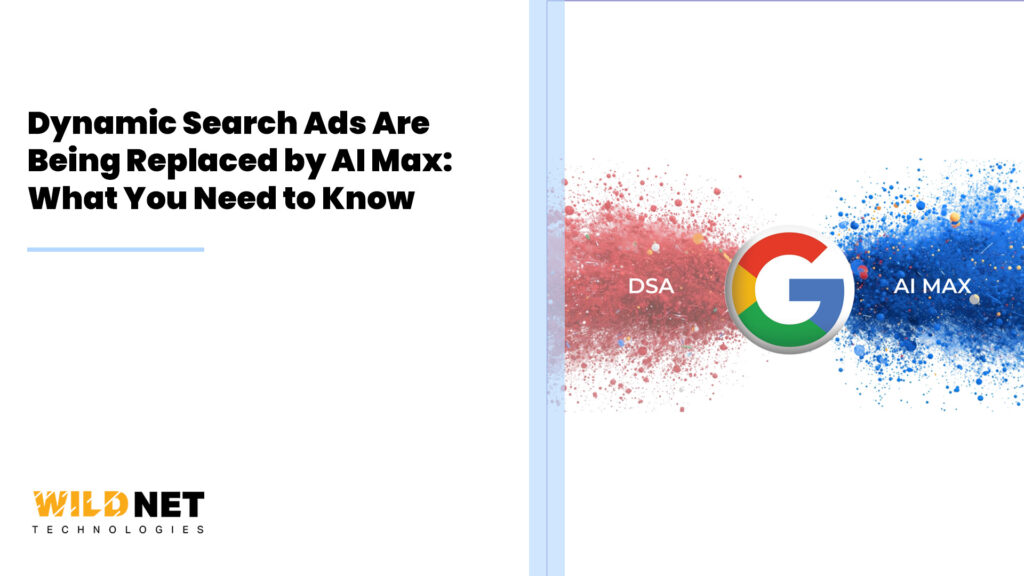
Google has now made it official: Dynamic Search Ads (DSA) are being deprecated, and their core functionality is being absorbed into a new system called AI Max.
While this move has been anticipated for a while, the confirmation changes things for advertisers who still rely on DSA for scaling search campaigns.
Starting in September, eligible campaigns using DSA, automatically created assets (ACA), and certain broad match settings will begin transitioning — whether advertisers are ready or not.
This isn’t just a product update. It’s a clear signal of where Google Ads is heading next.
The End of DSA (As We Know It)
For years, Dynamic Search Ads played a specific role in Google Ads accounts.
They helped advertisers capture additional search demand beyond their keyword lists by using website content to dynamically generate headlines and select landing pages. For large websites, eCommerce stores, and inventory-heavy businesses, DSAs were often a reliable way to scale without constant manual input.
But that model had limitations.
It relied heavily on page matching, not deeper intent. As search behavior evolved, that approach started to feel restrictive — especially in a world where users search in more complex, unpredictable ways.
Google’s answer to that limitation is AI Max.
AI Max: Not Just an Upgrade, But a Shift in Approach
AI Max builds on the foundation of DSA but expands it significantly.
Instead of only using your website to match queries, it combines multiple layers of data:
- Your ad assets
- Landing page content
- Broader intent signals
- User behavior patterns
The result is a system that doesn’t just match queries — it tries to understand intent and generate the most relevant ad experience in real time.
At the same time, Google is introducing more controls than advertisers had with traditional DSA. These include options around brand safety, location targeting, messaging guidance, and how search terms are matched.
There’s also flexibility in how landing pages are selected, thanks to features like final URL expansion.
A Gradual Rollout — But a Firm Deadline
Google is handling the transition in two stages.
Initially, advertisers will have the option to upgrade their campaigns manually. This phase gives more control — allowing you to test, restructure, and understand how AI Max behaves within your account.
However, this flexibility won’t last forever.
By September, any remaining eligible campaigns using legacy DSA setups will be automatically upgraded. Google has indicated that all migrations should be completed by the end of that month.
Depending on how your campaigns are currently configured, different AI Max features will be enabled by default. Some accounts may get full functionality immediately, while others will transition more gradually.
Performance Expectations: Promising, But Not Guaranteed
Google reports that campaigns using the full AI Max setup are seeing modest improvements in conversions or conversion value, while maintaining similar efficiency levels.
That sounds promising — but it’s important to interpret it carefully.
Performance averages don’t reflect every account. What works well for one business model may not translate directly to another. Lead generation, eCommerce, and local service advertisers all operate differently, and AI-driven systems can behave unpredictably across these contexts.
This is why testing will matter more than ever.
What Advertisers Should Focus On Right Now
With the transition approaching, the priority isn’t just upgrading — it’s preparing strategically.
The first step is understanding how much value DSA currently brings to your account. For some advertisers, it’s a core growth driver. For others, it’s a background campaign capturing incremental traffic. That distinction will shape how aggressively you approach the transition.
If DSA plays an important role, moving early gives you more control. A manual upgrade allows you to adjust settings, refine structure, and test performance before Google forces the change.
It’s also important to establish a clear performance baseline. Looking at recent data — conversions, search queries, landing pages, and efficiency metrics — will help you measure whether AI Max is actually improving results after migration.
The New Reality: Inputs Matter More Than Ever
As automation increases, the role of the advertiser shifts.
With AI Max, success depends less on manual keyword control and more on the quality of your inputs.
Your website content becomes a key signal. If your pages are unclear, duplicated, or poorly structured, AI systems will struggle to match them effectively.
Your data also plays a critical role. Conversion tracking, audience signals, and historical performance all influence how the system optimizes campaigns.
And then there are the new controls. While AI Max automates execution, it still relies on guidance — things like brand settings, location inputs, and messaging direction can significantly impact outcomes.
What to Watch After Migration
Once campaigns transition to AI Max, close monitoring becomes essential.
Pay attention to how search terms evolve compared to your previous DSA campaigns. Are they more relevant, or drifting too broad?
Landing page selection is another key area. If automated URL expansion is enabled, you’ll want to ensure traffic is being directed to pages that actually convert.
Beyond that, focus on lead quality and conversion paths — not just volume. AI systems can increase traffic, but not always in ways that align with business goals.
Looking Ahead
The retirement of Dynamic Search Ads marks the end of a familiar approach to scaling search campaigns.
In its place, Google is building a system that relies on automation, intent modeling, and real-time decision-making.
AI Max isn’t just replacing DSA — it’s redefining how search campaigns are managed.
For advertisers, the challenge is clear:
adapt early, test thoroughly, and focus on the inputs that guide the system.
Because in this new environment, success won’t come from controlling every detail —
it will come from training the machine to make better decisions.
As businesses adapt to Google’s shift toward AI-driven advertising, partnering with the right agency becomes critical. Wildnet Technologies provides comprehensive Digital Marketing Services along with performance-driven PPC services designed for this new AI-first landscape. By combining SEO, content, and paid media strategies, Wildnet helps brands feed high-quality signals into platforms like AI Max, enabling smarter targeting and better conversions. Their integrated approach ensures consistent messaging, faster optimization, and stronger control over campaign performance—helping businesses stay competitive as search advertising becomes increasingly automated.
FAQ
1. What is replacing Dynamic Search Ads (DSA) in Google Ads?
Dynamic Search Ads are being replaced by AI Max, Google’s new AI-powered advertising framework that combines website content, user intent, and multiple signals to automatically generate and optimize ads.
2. When will DSA campaigns be discontinued?
Google has announced that starting September, advertisers will no longer be able to create new DSA campaigns, and existing eligible campaigns will be automatically migrated to AI Max by the end of the month.
3. How is AI Max different from Dynamic Search Ads?
While DSA focused mainly on matching website content to search queries, AI Max goes further by using real-time intent signals, automation, and AI-generated creatives to improve targeting, bidding, and overall campaign performance.
4. Will AI Max improve campaign performance?
Google reports that AI Max can drive higher conversions or conversion value at similar CPA or ROAS, but actual results may vary depending on the industry, data quality, and campaign setup.
5. How can advertisers prepare for the transition to AI Max?
Advertisers should review current DSA performance, test AI Max early, improve website content and tracking, and closely monitor search terms and landing pages after migration to ensure optimal results.
Read More
- The Strategic Use of Different Marketing Channels and Its Impact on Business Growth
- To Improve Your Website’s SEO Performance, When Should You Update Your SEO Plan?
- How to Choose the Right Law Firm Internet Marketing Company
- How to Choose a Reliable Law Firm Content Marketing Agency
- Internet Marketing Services for Local Businesses: What You Need and Why