Summary
Marketing analytics is getting smarter, and AI is the reason behind it. Be it the cause or the need, digital marketing services in 2025 and beyond are experiencing a massive shift due to AIs.
With an AI marketing agency, any brand or marketing agency can leverage the most of it to deliver marketing campaigns that blow minds and convert users.
But without it, marketing would be more challenging and expensive day by day.
Key Takeaways
- AI-driven marketing analytics empowers marketers to predict trends, optimize campaigns, and improve ROI.
- Businesses can achieve real-time insights by integrating AI tools with marketing analytics platforms.
- A strong data infrastructure and human oversight are critical for ethical & practical analytics.
- Personalization, predictive analytics, and automation are the three pillars of AI-driven marketing analytics success.
Table of Contents
- A few facts about Marketing Analytics
- What Are Marketing Analytics?
- How AI Elevates Marketing Analytics?
- Digital Marketing vs Data Analytics: Which Is Better?
- Conclusion
- FAQs
The marketing world thrives on data. Yet, the real challenge lies not in collecting information but in interpreting it effectively.
Enter AI-powered marketing analytics, a game-changer that helps brands transition from reactive decision-making to predictive intelligence. With AI, marketers no longer rely on assumptions; they can now decode customer behaviour, optimize spending, and predict outcomes precisely.
A few facts about Marketing Analytics
- 98% of the sales experts rely on trustworthy data before pivoting.
- 88% of marketers are using analytics tools in 2025.
- Just 31% of the marketing experts are delighted with their data collection ability.
- The marketing analysis market share will cross USD 6.2 billion in 2025 and reach USD 11.53 billion in 2029.
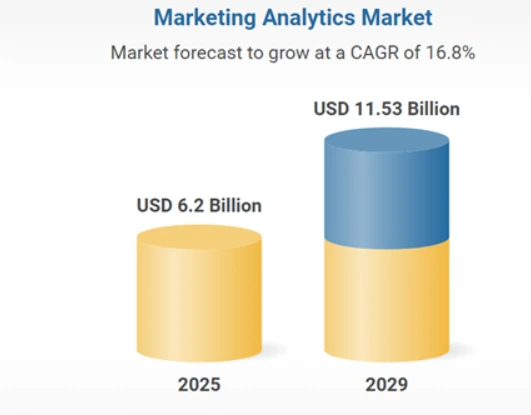
The market share of Marketing analytics in 2025 and 2029.
- The proven results of using smarter marketing analysis to power the content strategy 2025 can be seen below, per a reliable AI company.

Generic Content vs Personalized Content in 2025
What Are Marketing Analytics?
Marketing analytics involves collecting, measuring, and interpreting marketing data to evaluate performance & identify growth opportunities. It answers the key question: What’s working and what’s not?
Incorporating AI into marketing analytics allows brands to process complex datasets from multiple channels, uncover deep insights, and predict future outcomes. It’s not just about tracking but about understanding and acting faster.
Why Marketing Analytics Matters?
Businesses need clarity amidst deafening digital noise. That’s where marketing analysis steps in. It helps:
- Identify the most profitable customer segments.
- Allocate marketing budgets efficiently.
- Optimize ad placements and creative strategies.
- Measure real-time campaign effectiveness.
The question of “why marketing analytics matters” is answered simply by the competitive edge a brand gets with it.
How AI Elevates Marketing Analytics?
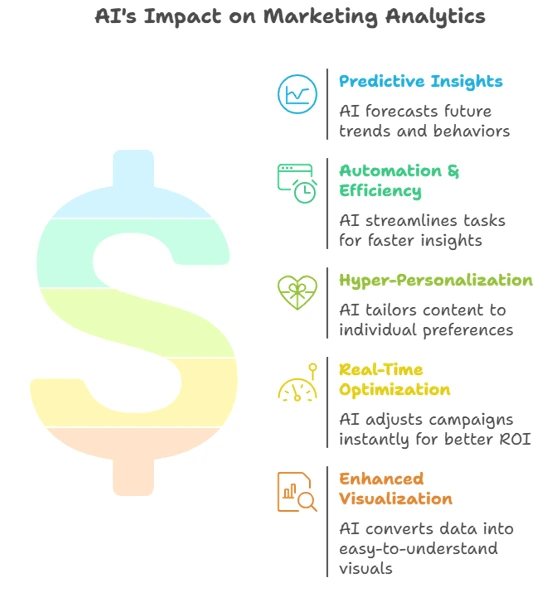
Benefits of AI Marketing Analytics
AI amplifies the scope and accuracy of marketing analytics through:
1. Predictive Insights
AI predicts customer behaviour, campaign performance, and market trends before they unfold. Predictive modelling helps marketers make proactive decisions rather than reactive corrections.
2. Automation & Efficiency
From audience segmentation to report generation, AI automates manual tasks, ensuring faster insights and reduced errors.
3. Hyper-Personalization
By analyzing customer data in real time, AI tailors the content and offers personalized campaigns that resonate with individual preferences.
4. Real-Time Optimization
AI-powered marketing analysis tools can instantly adjust bids, budgets, and creative direction, maximizing campaign ROI.
5. Enhanced Visualization
Through dashboards and data storytelling, AI converts complex data into easy-to-understand visuals for marketing teams.
Loving the benefits? Wildnet delivers much more…
Key Use Cases of AI in Marketing Analytics
Here are some use cases of AI in marketing analytics in 2025,
- Predictive Modelling: Anticipate customer churn or future buying behaviour.
- Customer Segmentation: AI divides audiences into micro-segments for targeted messaging.
- Sentiment Analysis: Measure brand perception and customer satisfaction.
- Ad Performance Optimization: Identify which creatives drive engagement and conversions.
- Attribution Modelling: Understand which channels contribute most to conversions.
These applications transform digital marketing analytics from reactive reporting to strategic foresight.
Choosing the Right Marketing Analytics Tools
With several options available, selecting the right marketing analysis tools is crucial.
Platforms like Google Analytics, Pixis AI, and IBM Watson Marketing offer advanced automation & visualization features.
If you’re wondering what is Google Analytics in digital marketing, it’s a web-based tool that tracks website traffic, user behaviour, and conversions. It remains an essential part of web analytics in digital marketing ecosystems, especially when integrated with AI-driven insights.
AI and Web Analytics in Digital Marketing
Web analytics in digital marketing focus on website data, from session time to conversion rates. AI enhances this by identifying user intent, optimizing content, and predicting drop-offs before they occur. It helps transform website performance metrics into actionable marketing strategies.
In short, AI is the best helper in marketing analysis.
Digital Marketing vs Data Analytics: Which Is Better?
The debate over “digital marketing vs data analytics which is better” is misplaced, as both are interconnected.
While digital marketing focuses on strategy and execution, data analytics ensures those strategies are grounded in real-world insights. Together, they form the foundation of marketing analytics success.
How to Build an AI-Driven Analytics Framework?
To create a scalable marketing analytics ecosystem:
- Define clear objectives: Identify measurable KPIs
- Ensure data quality: Clean, structured, and unified datasets are essential.
- Integrate AI tools: Combine automation with analytics software
- Empower teams: Upskill marketers to work with AI insights
- Monitor performance: Continuously refine models for accuracy and relevance
These steps ensure your brand leverages AI for sustainable & insight-driven marketing.
Conclusion
In 2025 and beyond, marketing analytics will be at the heart of every successful digital campaign. AI transforms how marketers gather, interpret, and act on data — making campaigns more adaptive, predictive, and profitable.
As competition intensifies, partnering with AI-powered analytics platforms isn’t a luxury; it’s a necessity. Brands that embrace this evolution today will lead tomorrow.
Wildnet Technologies is a leading digital marketing company that uses AI marketing analytics to help its clients resonate with users’ desires and demands.
Wish to Know More?
> Smart Moves: 5 AI Marketing Case Studies That Justify ROI
> AI-First Agencies: How White Label Partners are Powering Global Campaigns?
> Glossary (Jargonify Yourselves)
> Digital Yum (Upgrade every week for Free)
Connect with us at info[@]wildnettechnologies.com to experience the power of smarter marketing analysis.
FAQs
Question 1. What is marketing analytics?
Answer 1: Marketing analysis involves collecting and analyzing marketing data to measure performance & optimize strategy. Without it, brands and marketers are shooting arrows in the dark, which costs a considerable chunk of the marketing budget.
Question 2. What is web analytics in digital marketing?
Answer 2: It refers to tracking and analyzing website data to understand user behaviour & improve online campaigns. Websites are the digital storefronts of businesses, and thus, they need to be optimized on a regular basis.
Question 3. Why marketing analytics is important?
Answer 3: It helps brands make data-driven decisions, improve ROI, and stay competitive. Thus, it makes the future marketing strategizing a piece of cake.
Question 4. How is AI changing marketing analytics?
Answer 4: AI automates data processing, enhances accuracy, and delivers predictive insights that help marketers act smarter & faster. This is a dream come true for marketers across the globe.
Question 5. How is Wildnet helping its Clients with AI Marketing services?
Answer 5: AIs can do everything, including AI market analytics, ideation, creation, implementation, monitoring, and constant optimization. Marketing in the AI era needs all these uplifts and more.
With Wildnet, the AI-first company, brands in India are making the most of the digital evolution we are experiencing. Plus, the results are delivered faster and at a lower cost than traditional marketing.
Isn’t this what all brands need?