
Summary
Experiential Marketing has evolved from a “nice-to-have” activation into a core growth driver in 2026. As consumers value emotions, memories, and shareable moments over passive ads, experiences have become powerful social currency. Brands that understand and adopt experiential strategies are not only driving engagement but also building long-term loyalty & advocacy.
Key Takeaways
- Experiential Marketing creates emotional connections that traditional ads can’t.
- Experiences now function as social currency; people value and share them.
- Knowing why experiential marketing is important helps brands stay relevant.
- Precise planning, execution, and measurement are critical for success.
- Brands that invest early will outperform those that rely solely on impressions.
Table of Contents
⤷ Why is Experiential Marketing Important in 2026?
- Experiential Marketing 101: The Wildnet Style
- How can Wildnet help as an Experiential Marketing Agency?
- Conclusion
- FAQs
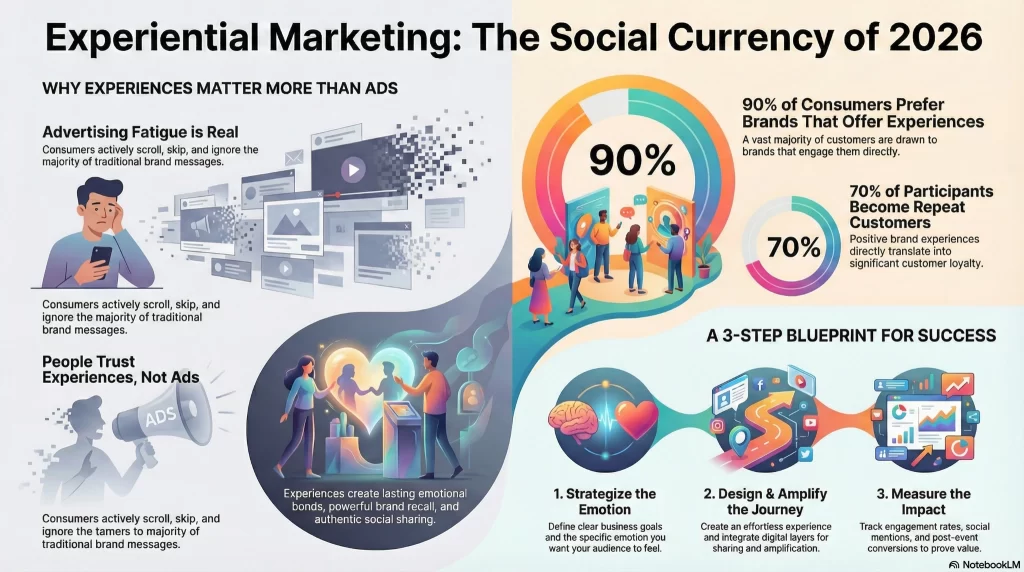
Advertising fatigue is real. Consumers scroll, skip, mute, and ignore most brand messages.
What stops them? Experiences.
In 2026, people don’t just buy products; they buy stories, emotions, and moments worth talking about. That’s precisely why it has become the new social currency, especially in markets like India, where experience-led consumption is quietly reshaping brand value.
A few facts about Experience-focused Marketing
- 50% of companies plan to try it by the end of 2026.
- 90% of consumers prefer brands that leverage experience-based marketing.
- 70% of the participants tend to become repeat customers.
- 72% of Millennials choose brands that offer unique experiences.
- 58% of users are more likely to share their experiences on social media.
What is Experiential Marketing?
Experience-driven marketing is a strategy that allows consumers to actively engage with a brand through immersive & memorable experiences instead of passive messaging. These experiences are designed to spark emotion, participation, and recall, turning audiences into participants rather than spectators.
Unlike traditional advertising, it is felt, lived, and remembered. According to renowned marketing agencies, modern experiences are no longer “consumed”; they are co-created by brands and audiences together.
The Social Currency of 2026: Does Your Brand have it?
Why is Experiential Marketing Important in 2026?
Understanding why experiential marketing is important in 2026 comes down to one truth:
People trust experiences more than ads.
And here’s why it happens,
Emotional Connection beats Visibility
People remember how a brand made them feel, not how often they saw it across various digital channels.
Social Sharing multiplies Reach
Great user experiences naturally translate into content, conversations, and word of mouth.
Human Connection is back
After years of digital overload, consumers crave real interactions, and this demand is going to skyrocket with a myriad of generative AI content.
Recent experiential marketing news also shows that brands investing in immersive & community-driven experiences are seeing stronger engagement, higher loyalty, and longer brand recall than those relying purely on performance media.
Benefits of Experiential Marketing
The long-term benefits of experiential marketing include:
- Stronger emotional bonds with consumers
- Higher brand recall than traditional advertising
- Increased organic reach through social sharing
- Better audience insights
- Improved trust and loyalty
In 2026, these benefits directly translate into a competitive advantage.
Examples of Experiential Marketing in 2025
If you’re wondering what is an example of experiential marketing, here are a few patterns brands used successfully in 2025:
- Immersive brand pop-ups: Tech & lifestyle brands hosted interactive spaces where people could explore products, attend workshops, and share content socially.
- Cultural & community-led activations: Indian brands leaned into local culture, art, and storytelling, creating experiences people felt proud to associate with.
- Hybrid experiences: Offline activations amplified through digital touchpoints, QR journeys, and social challenges.
These examples prove that experience-based marketing isn’t about scale alone; it’s about impact.
Experiential Marketing 101: The Wildnet Style
Now, it’s time to help you with a cheat sheet.
How to Create an Experiential Marketing Campaign?
To understand how to create an experiential marketing campaign, brands need clarity, not complexity:
- Start with the emotion you want people to feel.
- Choose the proper experience format (event, pop-up, installation, & community meet)
- Integrate digital layers for sharing and amplification.
- Make participation effortless and rewarding.
- Plan what happens after the experience.
Strong campaigns don’t end when the event does; they live on through stories.
How to Write an Experiential Marketing Strategy?
If you’re planning long-term growth, knowing how to write an experiential marketing strategy is essential:
- Define clear business and brand objectives.
- Understand your audience’s emotional triggers.
- Design the experience journey step-by-step.
- Align creative, media, and on-ground execution.
- Decide success metrics before launch.
A strategy-first approach ensures experiences don’t become expensive one-offs.
How to Measure Experiential Marketing?
A common myth is that experiences can’t be measured. In reality, how to measure experiential marketing is clearer than ever by focusing on the metrics below.
- Engagement duration and participation rates
- Social mentions, shares, and UGC
- Sentiment analysis and feedback surveys
- Lead quality and post-event conversions
- Brand recall and preference lift
Measurement transforms experiences into scalable business assets.
How can Wildnet help as an Experiential Marketing Agency?
Many brands partner with an experiential marketing agency, like Wildnet Technologies, to bring ideas to life efficiently. These agencies offer end-to-end experiential marketing services, including strategy, creative, production, tech integration, and performance tracking.
The right agency doesn’t just execute; it helps brands design experiences that build lasting emotional equity.
Conclusion
Experiential Marketing is no longer a trend; it’s the social currency of 2026.
Brands that create meaningful, shareable, & emotionally resonant experiences will win attention, trust, and loyalty. Those who ignore it risk becoming invisible. If your brand wants to be remembered, talked about, and chosen, experiences are the way forward.
Wildnet Technologies Ltd is a trusted Experiential Marketing Agency in India that has helped more than 4,100 clients impart happy memories in their customers’ hearts.
Wish to read more?
> Comic Con India & Experiential Marketing: 10 Tips for Brands
> Before Planning Strategy, Read This: 2026 Trends Marketing
> Glossary (Free Digital Dictionary)
> Wildnet’s Digital Yum (Free upskilling)
Contact us now at info[@]wildnettechnologies.com and become the Brand of 2026.
FAQs
Question 1. How is AI helping with Experiential Marketing?
Answer 1: AI helps experience-based marketing by
- Personalizing experiences in real time,
- Analyzing audience behaviour,
- Enabling interactive tech like AR/VR,
- Predicting engagement patterns, and
- Optimizing campaigns through data-driven insights before, during, & after live brand activations.
Question 2. Why experiential marketing is important today?
Answer 2: Because consumers trust live experiences more than ads, making the said experiences powerful drivers of brand loyalty and advocacy.
Question 3. What is an example of experiential marketing?
Answer 3: Brand pop-ups, immersive installations, community-led events, and interactive activations are key examples of marketing through experiences.
Question 4. How to measure experiential marketing success?
Answer 4: Through engagement metrics, social amplification, sentiment, leads, and post-campaign impact, brands & marketers can measure the success of experience-powered marketing.
Question 5. How do brands leverage Comic Con India to do experiential marketing?
Answer 5: Brands leverage Comic Con India by tapping into pop-culture fandoms through,
- immersive booths,
- character-led experiences,
- exclusive launches,
- interactive games, and
- social-media-worthy moments that emotionally connect fans with the brand.