Summary
Marketing has moved beyond SEO, PPC, and SMM, the key pillars of digital marketing. It is happening because the market, the customers and tools are evolving together.
To win, brands need to leverage positioning in marketing, starting with an understanding of what brand positioning is, how to leverage it & make it their new competitive edge.
Key Takeaways
- Positioning in marketing helps brands carve out a distinct identity and gain a competitive advantage.
- A clear positioning strategy in marketing shapes consumer perception, builds loyalty, and enables premium pricing.
- In 2026, integrating AI marketing (data-driven insights, personalization, & automation) enhances positioning efforts.
- Brands that fail to update their positioning strategy risk becoming invisible in saturated markets.
Table of Contents
⤷ What is Product Positioning in Marketing?
- Why Do Brands Need a Positioning Strategy in Marketing in 2026?
- What is the Role of AI Marketing in Reinforcing Positioning?
- How to Build a Positioning Strategy in Marketing for 2026?
- Conclusion
- FAQs
You’ve probably noticed how some brands pop out immediately – their messaging feels sharp, their identity resonates, and they seem to connect with you on a deeper level. That’s no accident. What you’re witnessing is the power of positioning in marketing.
In 2026, when digital noise is louder than ever, good products alone won’t cut it. Brands will need to think carefully about what they represent, whom they serve, and how they say it. Add AI marketing into the mix, and you will have the combination that transforms a good brand into a memorable one.
A few facts about Positioning in Marketing
- As per HubSpot’s 2025 State of Marketing, marketers are targeting Millennials and Gen Z the most.
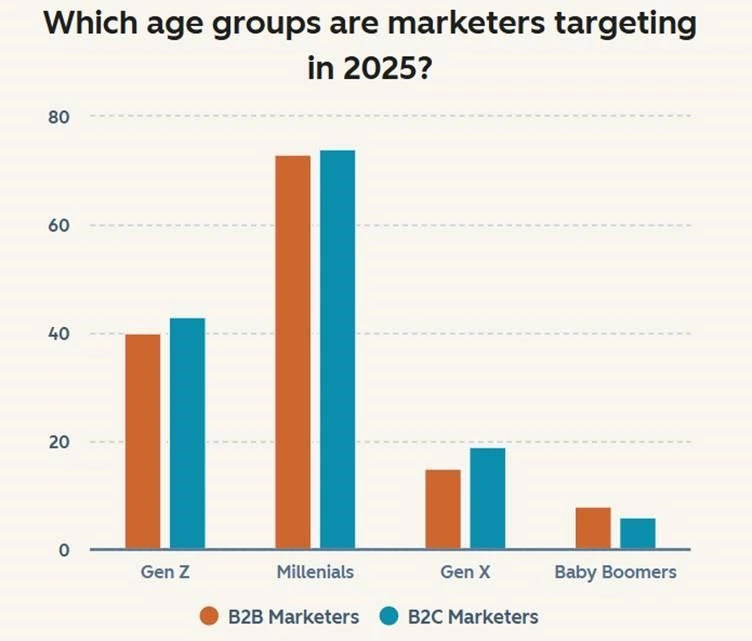
The Age Groups Targeted by B2B & B2C Brand Marketers in 2025.
- To engage such a young public, your marketing team must continuously adapt based on customer feedback & performance data, and personalise the brand messaging accordingly.
- Key examples of excellent positioning in marketing include Apple’s pristine offerings, Beautycounter’s clean beauty lineup, Allbirds’ 100% carbon-neutral products, and, lastly, the general public using the phrase “Thank you for coming to my TED Talk” while sharing long-form content.
- Wildnet Technologies Ltd is delivering top positioning in marketing for its clients through AI + Human marketing.
- According to McKinsey, 64% of surveyed brands in 2025 reported cost-cutting and revenue gains by switching to AI.
What is Positioning in Marketing?
So, what is positioning in marketing, exactly? In simple terms, positioning in marketing is the process of carving out a distinct place for your brand or product in your target customers’ minds.
A good “what does positioning mean in marketing” approach includes:
- Clearly defining what makes your brand unique (your value proposition or USP, unique selling proposition).
- Understanding the competitive landscape: who else is trying to own that mental space, and how your brand is different.
- Crafting a positioning statement in marketing via a brand positioning statement that articulates who you are, who you serve, and the benefit you deliver.
When done right, positioning in marketing shapes how consumers perceive your brand, and this perception becomes reality.
What is Product Positioning in Marketing?
It’s effectively the same idea, but it focuses specifically on a product covering angles such as
– Where it sits in the market relative to alternatives, and
– What niche or consumer needs it addresses.
Thus, positioning in marketing (and product positioning in marketing) is not just “advertising.” It’s strategic: it determines what your brand or product means to customers.
Why Do Brands Need a Positioning Strategy in Marketing in 2026?
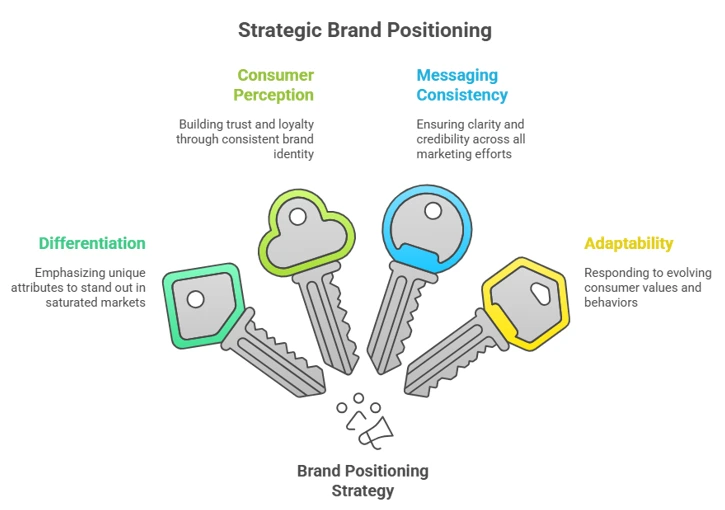
The 2026 Brand Positioning Strategy
Brands need that edge that beats all their competition and makes them the ideal choice for their customers. Positioning themselves via a personalized marketing strategy is a great way to do that.
Let’s dive deeper…
1. Cut through the Noise in Saturated Markets
The basic benefit of positioning is differentiation. In a crowded market, positioning strategies in marketing help a brand stand out by emphasizing unique attributes, values, or promises. Without a deliberate positioning strategy in marketing, brands risk being just “another face in the crowd.”
2. Build Consumer Perception, Trust and Loyalty
Positioning helps shape how consumers see your brand. A consistent & authentic brand identity builds emotional connection and trust. Once established, this perception can lead to premium pricing, in which consumers are often willing to pay more for brands they perceive as unique, high-value, or aligned with their values.
3. Enable Strategic Marketing and Consistent Messaging
A well-defined positioning statement gives clarity. It becomes the foundation for all marketing messages, campaigns, product design, and communication, ensuring consistency across touchpoints. This clarity helps avoid mixed messaging, which erodes brand credibility.
4. Adapt to Evolving Consumer Values and Behaviours
In 2025 and beyond, consumers expect brands to be more than just sellers. They look for authenticity, purpose, and relevance. Positioning that reflects such values resonates more deeply.
As consumer preferences change, companies with flexible positioning strategies can pivot and remain relevant.
In short
Positioning in marketing isn’t optional anymore – it’s vital.
What is the Role of AI Marketing in Reinforcing Positioning?
2026 promises more than just traditional marketing as the wave of AI marketing is reshaping how positioning works – making it smarter, faster, and more data-driven.
- Hyper-personalization at Scale: AI marketing tools allow brands to deliver personalized experiences be it in the content, offers, or recommendations, all tailored to individual user preferences and behaviour.
- Data-driven Insights & Segmentation: Instead of broad segments, AI can help identify highly specific micro-segments, enabling a brand to position itself precisely to different audiences.
- Automation + Consistency: AI agents can manage campaigns, optimize ads, AB-test messaging, & adjust campaigns in real time, ensuring consistent brand tone and positioning across channels while reducing manual workload.
- Faster Adaptability: With AI-powered analytics, brands can monitor consumer sentiment, feedback, & performance data to quickly adapt their positioning or messaging and stay aligned with market shifts.
In 2026, “positioning strategy in marketing” without “AI marketing” would be like running a sprint with one shoe – possible, but not optimal. The two complement each other now more than ever.
How to Build a Positioning Strategy in Marketing for 2026?
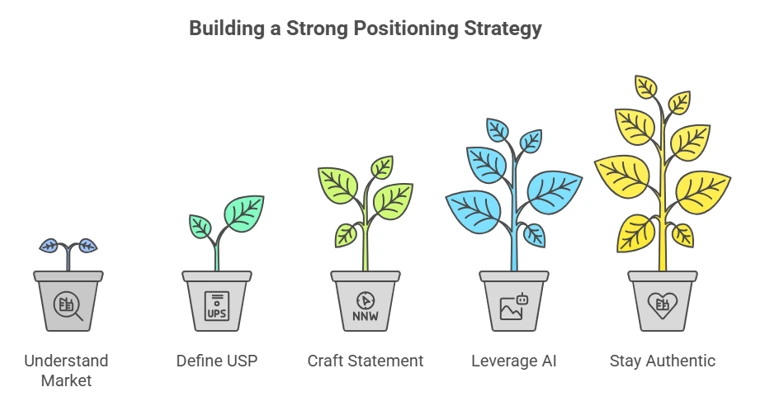
5-step Strategy to Awesome Brand Positioning In Marketing
If you are a brand or startup wanting to build a solid positioning in marketing today (or refresh an existing one), Wildnet is here with a roadmap:
Step 1: Understand your Market and Audience deeply
- Conduct competitor analysis and market research to identify gaps. Use perceptual mapping or similar tools to see where your brand could uniquely fit.
- Define your target customer: who they are, what they care about, and what problems they have.
Step 2: Define Your Unique Value Proposition / USP
Clarify what your brand offers that others don’t – quality, price, values, convenience, ethical practice, innovation, and more. This becomes your positioning statement in marketing.
Step 3: Craft a Positioning Statement
- Answer all the questions starting with “W” about your brand, such as “Who you are”, “Who you serve”, “What your unique benefit is”, “Why you are different” and summarize them in a sharp & clear brand positioning statement.
- Use this as a guiding north star for all communications, branding, and product decisions.
Step 4: Leverage AI Marketing Tools to Amplify Positioning
Use AI to,
– Personalize content, offers, and communications to ensure your brand messaging resonates with different micro-segments.
– Track how well your positioning is resonating in terms of engagement, conversion rates, sentiment, and loyalty.
– Automate marketing workflows, but keep quality and authenticity intact, i.e., AI should reinforce, not replace, your brand story.
Step 5: Stay Authentic and Values-aligned
- Consumers increasingly value purpose, transparency, and authenticity. Positioning strategies in marketing that reflect fundamental values, rather than just marketing rhetoric, will build stronger trust.
- Back positioning claims with actions – ethical practices, customer experience, and quality assurance.
These five steps can take any brand to the top of its market and place it on the throne for years to come.
Conclusion
As we move into 2026, the competition for customers’ attention and loyalty will only get tougher. In that environment, positioning in marketing won’t be a “nice-to-have”; it’ll be non-negotiable.
But more than that: Brands that pair a precise & strategic positioning with modern tools like AI marketing will enjoy a decisive advantage. They’ll be able to deliver personalized experiences, remain relevant in rapidly shifting markets, and build deeper emotional connections with customers.
If you want your brand to stand out and not just survive, invest in positioning strategy in marketing today because tomorrow will reward those who get it right.
Wildnet Technologies Ltd is a preferred destination for brands seeking new-age marketing, and our 4100+ clients are a testament to that.
Wish to read more?
> What is Creative Fatigue in the Age of AI Marketing?
> Need Organic Marketing 2025? Try AI SEO, SXO & Instagram SEO
> Glossary (Your digital jargon dictionary)
Connect with us now at info[@]wildnettechnologies.com and get the best brand positioning in marketing.
FAQs
Question 1: What is positioning in marketing in 2025?
Answer 1: Positioning in marketing is the strategic process of defining and embedding a distinct place in terms of identity, value, and perception for your brand or product in the minds of your target customers.
Question 2: What does positioning mean in marketing for 2026?
Answer 2: It means consciously crafting how you want your brand to be perceived by your audience,
- What unique value do you offer,
- How you differ from competitors, and
- Why customers should care.
Question 3: What is a positioning statement in marketing?
Answer 3: A positioning statement is a crisp internal declaration summarizing,
- who the brand serves,
- what it offers,
- how it’s unique, and
- why it matters to customers.
It guides all brand communication, product design, and marketing strategy.
Question 4: What is product positioning in marketing vs brand positioning in marketing?
Answer 4: Product positioning in marketing refers to where a particular product sits in the market, be it niche, benefits, or value compared to alternatives.
Brand positioning in marketing refers to how the brand stands in consumers’ minds, encompassing identity, values, reputation, and emotional appeal. In simple words, product positioning is a smaller aspect of brand positioning.
Question 5: How does AI marketing influence positioning in marketing?
Answer 5: AI marketing enhances positioning by enabling hyper-personalization, data-driven targeting, automated campaign optimization, and real-time insights. This ensures that brand messages stay relevant, resonate with different audience segments, and adapt rapidly to changing trends, amplifying the effectiveness of positioning strategies.