+1 (212) 901 8616
 +91-880-044-0643

Summary
For years, marketing for education has relied heavily on promoting features, be it infrastructure, curriculum lists, faculty credentials, or accreditations. While important, these alone no longer influence modern learners.
In 2025 and beyond, success belongs to the institutions that communicate outcomes: employability, skill readiness, career mobility, and real-world impact. This newsletter explores why outcome-first thinking is reshaping marketing in education and how edtech brands can adapt.
Key Takeaways
- Feature-led education marketing is losing relevance and trust.
- Outcome-first narratives drive higher engagement and intent.
- AI-enabled personalization amplifies results when guided by human insight.
- Institutions adopting outcome storytelling see stronger enrolment quality.
- Wildnet Technologies leads this shift with AI + Human marketing excellence.
Table of Contents
- A few facts about Marketing for the Education Sector
- Why Feature-Led Education Marketing Is Failing in 2025?
⤷ Feature Marketing vs Outcome Marketing
- The Role of AI in Outcome-First Education Marketing
- How Wildnet Technologies is Shaping the Future?
- Conclusion
- FAQs
The conversation around marketing for education is changing fast.
Students today don’t ask, “What facilities do you have?”
They ask, “What will I become after studying here?”
Yet, many edtech companies still build their marketing strategy for educational institutes around brochures filled with features. In an era shaped by intent-driven search, AI recommendations, and informed decision-making, this gap is costing brands attention, trust & enrolments.
Outcome-first storytelling is no longer optional – it’s foundational to a modern higher education marketing plan.
A few facts about Marketing for the Education Sector
- In India, around 10 million learners are using edtech platforms in 2025.
- In K-12 learning programs, 38% of the users face issues related to the features provided by edtech institutions.
- While in the case of JEE, NEET and other UG prep courses, the top issues faced by learners were motivational (44%) & offering (29%) related.
- But when it comes to professional upskilling, the top issues faced by learners were outcomes (16%), offerings (15%), and more.
These stats depict that currently, only professional upskilling takes outcomes into account.
Why Feature-Led Education Marketing Is Failing in 2025?
Traditional marketing in education focuses on what an institution offers, not what a student achieves.
Here’s the problem:
- Features are static
- Outcomes are aspirational
- Features talk to audiences (and they just listen)
- Outcomes speak to them (and they understand)
This disconnect is why many online marketing strategies for educational institutions struggle to convert traffic into applications, even with strong budgets.
Here are some more angles explaining it in depth,
Feature Overload Is Reducing Impact
Edtech platforms that rely heavily on feature-centric messaging see declining engagement as students skim but don’t connect. Modern learners expect relevance, not repetition.
Outcome-Focused Brands Win Attention
Education brands showcasing results such as placements, skill readiness, alumni journeys & more, align better with emerging higher ed marketing trends and see stronger intent signals.
Transparency Builds Trust
Outcome-based education systems emphasize measurable success, reduced dropouts, and higher employability. These values resonate deeply with the target audience when reflected in modern-day marketing for education strategies.
This is why the best marketing strategies for schools now prioritize outcomes over amenities.
What is Outcome-driven Education Marketing?
Outcome-driven education marketing shifts the focus from what institutions offer to what learners achieve. It communicates real results such as career readiness, skill transformation, and long-term impact, rather than surface-level features.
In a crowded digital landscape, outcomes create relevance, trust, and confident decision-making.
Feature Marketing vs Outcome Marketing
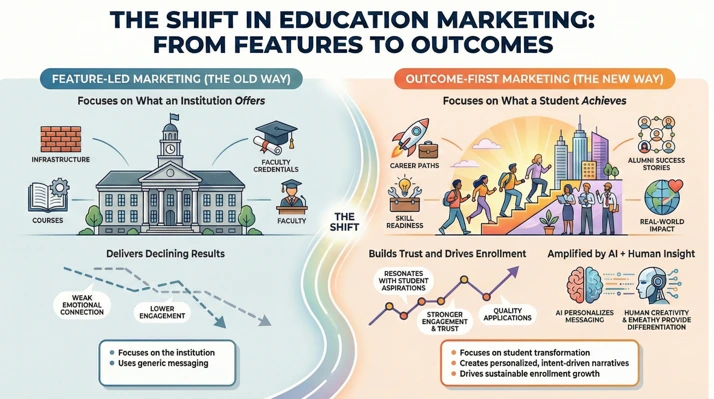
The Shift needed in Education Marketing for 2026
Now let’s compare the two to clarify once and for all why traditional edtech marketing will not work in 2026.
| Feature-Led Marketing | Outcome-First Marketing |
|---|---|
| Lists infrastructure, courses & faculty | Highlights career paths and success stories |
| Generic messaging | Personalized & intent-driven narratives |
| Focuses on institution | Focuses on student transformation |
| Weak emotional connection | Strong trust and recall |
| Lower ROI over time | Sustainable enrolment growth |
Feature-Led Marketing vs Outcome-First Marketing: The Edtech Niche in 2026
For example:
The best marketing strategies for educational institutes today are outcome-centric because outcomes answer the only question that matters: “Will this choice improve my future?”
If your brand markets itself in the same way, then and only then will it break away from the rest and stand out in front of your target audience as the best option.
The Role of AI in Outcome-First Education Marketing
AI is accelerating the shift. A modern digital marketing strategy for schools, online learning platforms and more uses AI to:
- Personalize messaging by learner intent
- Predict decision journeys
- Optimize content for discovery across platforms
But AI alone isn’t enough. True differentiation happens when AI insights are combined with human creativity, empathy, and strategic thinking, especially in emotionally driven decisions like education.
How Wildnet Technologies is Shaping the Future?
At Wildnet Technologies, we believe the future of marketing for education lies in AI + Human intelligence.
Our approach helps edtech brands:
- Shift from feature-heavy messaging to outcome-led storytelling.
- Build scalable & insight-driven marketing strategies for colleges, online coaching institutions and more.
- Design performance-focused education funnels rooted in real results.
By blending AI marketing services with deep domain expertise, we help education brands communicate not just what they offer, but why it matters. That’s how marketing for education becomes impactful, future-proof, and human.
Conclusion
The education sector doesn’t need louder marketing; it needs clearer value.
Feature-focused campaigns may inform, but outcome-first strategies inspire action. Edtech businesses that evolve their marketing for education today will own attention, trust, and relevance tomorrow.
The shift isn’t coming. It’s already here.
Wildnet Technologies is your go-to partner when it comes to AI-driven and Outcome-focused Edtech marketing, all thanks to our 19+ years of experience and niche expertise.
Wish to know more?
- Online Manipal Education SEO Case Study | Organic Traffic boosted by 70%
- Why Marketing Strategy for Edtech Startup Fails to Covert?
- Glossary (A Quick Way to Stay Updated)
Connect with us now at info[@]wildnettechnologies.com and change your Marketing for a better tomorrow.
FAQs
Question 1. What is marketing for education?
Answer 1: Marketing for education refers to promoting schools, colleges, universities, coaching institutes, and online learning platforms using strategies that attract, engage, & convert prospective learners.
Question 2. Why is outcome-first marketing better for education brands?
Answer 2: Because learners care more about career outcomes, skills, and ROI than static features. In other words, they need to know how a particular course will impact their future and job prospects.
Question 3. What are the best marketing strategies for universities today?
Answer 3: Outcome storytelling, AI-powered personalization, authentic content, and data-driven decision-making are some of the best marketing strategies for educational institutions.
Question 4. How does AI help education marketing?
Answer 4: AI improves targeting, personalization, predictive insights, and content performance across platforms. With great marketing insights from a human expert, AI marketing can deliver wonders in the edtech sector.
Question 5. How can institutions update their higher education marketing plan?
Answer 5: By shifting from feature promotion to outcome communication supported by AI + human synergy, edtech companies can prepare for a bountiful future.