
Summary
In 2026, EdTech brands are under pressure to grow enrollments while controlling costs. This is where educational advertising outperforms traditional media by shifting the focus from selling to teaching. Instead of interrupting audiences, it aligns marketing with how learners research, compare, and decide, resulting in better engagement, stronger trust, & measurable ROI across modern digital channels.
Key Takeaways
- Educational advertising delivers higher-quality leads with lower spend by aligning ads with learner intent.
- Traditional advertising struggles with attribution, relevance, and rising costs.
- EdTech brands benefit most when marketing feels informative rather than promotional.
- The approach supports scalable growth without sacrificing credibility.
Table of Contents
- A few facts about Educational Advertising
- What is Educational Advertising?
- Why Educational Advertising Beats Traditional Ads in 2026?
- How is Wildnet the Answer for Educational Advertising?
- Conclusion
- FAQs
The way people discover learning opportunities has changed forever. In 2026, prospective learners don’t respond to flashy slogans or blanket campaigns; they research deeply, compare options, and look for proof before committing. Educational advertising works because it fits naturally into this decision-making journey, offering value before asking for action.
For EdTech brands offering online marketing degrees or certifications, marketing today is less about shouting louder and more about being helpful at the right moment. This is where traditional advertising starts to lose relevance.
A few facts about Educational Advertising
- 56% of users are likely to trust brands cited in AI-generated answers.
- Average cost per lead (CPL) in EdTech ranges from $142 for higher education to $157 for graduation to $128 for undergraduate programs, and more.
- 35% of edtech marketers are not happy with these CPLs.
- The key issues bugging the EdTech niche marketing are demand for personalized content, alignment of data & AI and growing preference for digital learning.
What is Educational Advertising?
At its core, educational advertising focuses on explaining, guiding, and informing audiences rather than pushing immediate conversions. It blends learning with promotion, helping users understand why a solution matters before being asked to choose it.
In 2026, this approach thrives because platforms reward relevance and usefulness. Whether someone is exploring digital marketing education online or comparing platforms, ads that educate feel less intrusive and more trustworthy, especially in a crowded digital ecosystem.
Why Educational Advertising Beats Traditional Ads in 2026?
5 key reasons why educational advertising is better than traditional ads in 2026 are listed below.
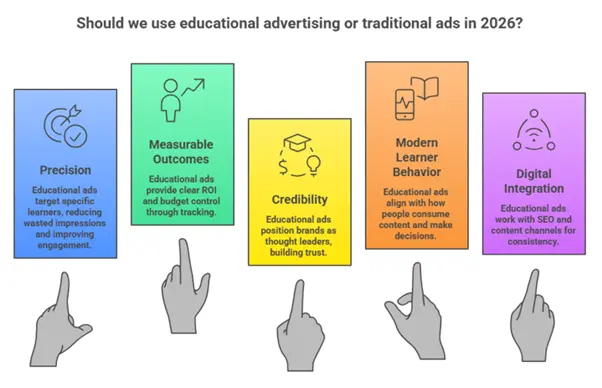
Five reasons why EdTech Brands should opt for Educational Advertising.
1. Precision beats Broad Exposure
Traditional ads aim for visibility; educational advertising aims for relevance. Instead of broadcasting the same message to everyone, it targets learners actively searching for growth, skills, or career advancement, particularly those engaged in digital marketing online learning. This precision reduces wasted impressions and improves the quality of engagement.
2. Measurable Outcomes and Smarter Budgets
One of the biggest challenges with traditional media is attribution. With educational advertising, every interaction, from content views to sign-ups, can be tracked and optimized. For brands leveraging digital marketing for educational institutions, this means clearer ROI and tighter control over spend.
3. Education builds Credibility
People trust brands that teach them something useful. Educational advertising positions EdTech companies as thought leaders rather than sellers. This is especially important in sectors where trust, outcomes, and long-term value matter more than impulse decisions.
4. Aligned with Modern Learner Behaviour
Today’s audience expects learning before commitment. Whether it’s a guide, webinar, or explainer ad, educational advertising integrates seamlessly with how people consume content & make decisions, bridging the gap between education and marketing without feeling forced.
5. Stronger Integration with Digital Ecosystems
Unlike isolated traditional campaigns, educational advertising works alongside SEO, content, and performance channels. For brands working with education marketing agencies, this integrated approach ensures consistency across touchpoints, from discovery to enrollment.
In short, EdTech ads run without niche expertise will not yield great outcomes, whereas educational advertising by an experienced marketing company can be the game-changer.
How is Wildnet the Answer for Educational Advertising?
Wildnet Technologies doesn’t treat edtech advertising as just another campaign format; it’s built into the entire growth framework. By combining AI-driven insights with human-led storytelling, Wildnet helps EdTech brands communicate value clearly while keeping costs efficient.
From audience research and intent mapping to content-led paid campaigns, our approach supports scalable education marketing without compromising credibility. Whether the goal is brand authority, enrollments, or long-term growth, the focus remains on relevance, not noise.
This becomes especially powerful in regulated or sensitive spaces, such as marketing in schools or niche platforms exploring eMarket education, where trust and clarity directly influence decision-making.
Conclusion
In 2026, educational advertising isn’t just outperforming traditional ads; it’s replacing them for brands that care about efficiency and impact. By educating first, EdTech companies reduce wasted spend, attract better-fit audiences, and build lasting trust.
Traditional advertising still has its place for awareness, but when growth, enrollments, and measurable ROI matter, the smarter path forward is clear:
Educate, Engage, and then Convert.
Wildnet Technologies Ltd is one of the leading educational advertising companies in India, and what makes them special is their AI + Human marketing approach.
Wish to know more?
> EdTech Stocking: Education Marketing Wins & Warnings 2026
> How Our Education SEO Strategy increased Organic Traffic by 70% for Online Manipal?
> Wildnet’s Digital Yum (Upskill every Week)
> Glossary (Digital Dictionary)
Connect with us at info[@]wildnettechnologies.com and run ad campaigns that deliver the best results.
FAQs
Question 1. Why is educational advertising more effective than traditional ads?
Answer 1: Because it aligns with how learners research and decide, delivering value before promotion. This is what users look for because they don’t have time to do in-depth research.
Question 2. Is educational advertising suitable only for EdTech brands?
Answer 2: No, but it is especially powerful in learning-led industries, where trust and clarity drive decision-making. It can be leveraged when a brand is new, introducing a new service or entering a new demographic.
Question 3. Does educational advertising cost more to execute?
Answer 3: Not necessarily, it often reduces overall spend by improving targeting and lead quality. All you need is a marketing partner that does educational advertising.
Question 4. How does this approach support long-term growth?
Answer 4: By building authority and trust, brands stay relevant beyond short-term campaigns. This is going to be a game-changer in 2026 because AIs are being used to search, and they prefer brands with sufficient credibility.
Question 5. Can educational advertising work with performance marketing?
Answer 5: Yes, when combined with data and optimization, it enhances both engagement & conversions. In a way, it’s the next upgrade.