Summary
In 2026, experiential marketing ROI can no longer be judged only by impressions or short-term buzz. As experiential marketing tactics evolve and sophisticated experiential marketing tools become mainstream, brands & experiential marketing agencies need deeper measurement frameworks that reflect real impact.
Brand loyalty, lifetime value, social amplification, and conversion paths across digital & physical touchpoints are precisely that.
Key Takeaways
- Experiential experiences drive deeper brand loyalty and measurable outcomes beyond reach.
- New frameworks for experiential marketing ROI blend data from live activations, digital engagement, and sales conversion.
- Hybrid & tech-driven campaigns will dominate in 2026, powered by AI marketing services and digital measurement tools.
- Executives and experiential marketing managers must rethink KPIs to reflect long-term ROI and business impact.
Table of Contents
- A few Experiential Marketing statistics
- What’s Changing in 2026?
- How to Measure Experiential Marketing ROI the New Way?
- Why Is Wildnet Built for the New Experiential Marketing ROI Era?
- Conclusion
- FAQs
In a world of endless ad noise, experiential marketing ROI offers brands a chance to create real human connections, turning passive audiences into active brand advocates. But CMOs consistently tell us the challenge isn’t impact; it’s measurement.
The old boxes of impressions, footfall counts, and vanity metrics just don’t cut it anymore. Experiential marketing ROI needs a new lens in 2026, one that blends experiential marketing activations with data intelligence and AI marketing services to show brand & business value.
A few Experiential Marketing statistics
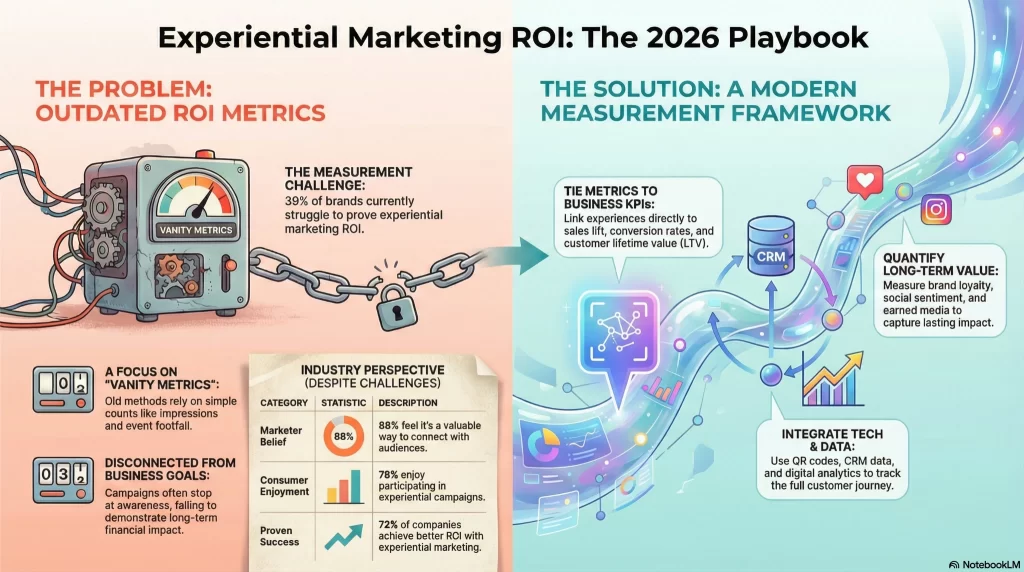
- 88% of marketers feel experiential marketing is a valuable way to connect with audiences.
- 78% of consumers enjoy taking part in an experiential marketing campaign.
- 39% of brands currently struggle to prove experiential marketing ROI.
- Using MMM (Marketing Mix Modelling) & MTA (Multi-Touch Attribution) helps in measuring ROI for experiential campaigns.
- 72% of companies have achieved better ROI with experiential marketing campaigns alongside their regular marketing activities.
What’s Changing in 2026?
Let’s start by understanding why 2026 is different.
From Impressions → Interaction
Traditional metrics like reach & impressions are giving way to engagement and experience metrics. Brands now prioritize quality of the interaction, from how long someone stays in an activation to whether they take action afterwards. This shift reflects broader trends in social media marketing and AI marketing services, where real engagement outweighs eyeballs.
Tech-Enabled Experiences
Experiential isn’t only physical anymore. AR/VR, AI personalization, smart experiential marketing displays and interactive storytelling are becoming commonplace. These tools help gather real-time data on user behaviour, preferences, and participation, opening new ways to measure experiential marketing ROI that were previously impossible.
Hybrid & Phygital (physical + digital) Are Norms
Hybrid experiences, where in-person activations tie into live-streamed events, digital rewards, and social engagement, are no longer optional. Such models expand reach and, when backed by experiential marketing tools & data pipelines, produce measurable conversion paths across platforms.
Experiential Marketing 2026: The Wildnet Way
How to Measure Experiential Marketing ROI the New Way?
To keep pace with these shifts in 2026, CMOs and experiential marketing managers should rethink ROI measurement beyond basic counts:
1. Tie Metrics to Business KPIs
Too many experiential briefs still stop at awareness. Instead, link experiential KPIs to:
- Sales lift
- Customer acquisition cost (CAC)
- Conversion rates
- Customer lifetime value (LTV)
These metrics translate experiential impact into bottom-line business outcomes.
2. Use Smart Attribution Models
Modern experiential marketing tools allow tagging participants via QR codes, UTM tags, NFC, or app hooks, tying event engagement to real conversions online & in-store.
3. Track Sentiment and Advocacy
Emotional response and brand loyalty are potent drivers of ROI. Post-event surveys, net promoter tracking, and social listening can quantify “experience affection” as a metric.
4. Integrate with Digital Analytics and CRM
Sync event data with your CRM to measure how many participants:
- Became leads
- Converted to customers
- Re-engaged with email or social channels
This converts experiential marketing activations into long-term revenue indicators.
5. Measure Social & Earned Impact
Engagement on social media marketing channels & earned media traces can be quantified in reach, sentiment, share of voice, and content amplification. These are the metrics that tie wider audience impacts back to specific experiences.
Examples of Measured Experiential Success
Below are a few examples of how to measure the success of experimental marketing.
Sensory & Immersive Experiences
Brands that design multi-sensory activations, including taste, sound, touch, and interactive displays, see measured increases in dwell time, preference lift, & share intent. These translate directly into deeper brand loyalty and measurable ROI gains.
Sampling That Converts
Experiential marketing sampling campaigns that collect real-time data at festivals or retail pop-ups help brands prove ROI by directly linking trials to sales & repeat purchase behaviour.
Hybrid Exhibits
Combining live physical interactions with digital engagement drives measurable conversion tunnels, from scanning QR codes on experiential marketing displays to downloading apps or following social channels, closing the loop between experience and purchase intent.
Why Is Wildnet Built for the New Experiential Marketing ROI Era?
In 2026, experiential marketing needs accountability, not just creativity. That’s where Wildnet fits in. We design experiences as measurable growth engines, not standalone campaigns, helping brands deliver real experiential marketing ROI that leadership teams can trust.
Wildnet connects experiential marketing activations directly to business outcomes through data-ready design, tech-enabled experiences, and integrated social media marketing. From immersive pop-ups to interactive experiential marketing displays, every touchpoint is built to capture intent, engagement, and post-experience action.
As an experiential marketing agency powered by analytics and AI marketing services, we give CMOs & experiential marketing managers clarity beyond footfall by linking experiences to conversion, loyalty, and long-term growth.
With us, experiential marketing stops being a “nice-to-have” and becomes a measurable growth driver.
Conclusion
If experiential marketing ROI is still evaluated with old metrics, CMOs risk underestimating its value. In 2026, experiences are more measurable, more connected to long-term loyalty, and more strategic than ever before.
When brands use the right experiential marketing tools, link their activations to hard business outcomes, and treat experiential as an integral part of customer journeys, they don’t just generate buzz; they drive brand growth that lasts.
Wildnet Technologies Ltd is an honoured partner of 4100+ clients, delightfully helping them build better brand images and stronger connections.
Wish to read more?
> What Is Experiential Marketing? The Social Currency of 2026
> Comic Con India & Experiential Marketing: 10 Tips for Brands
> Glossary (Your digital dictionary)
Connect with us at info[@]wildnettechnologies.com and supercharge your experiential marketing ROI.
FAQs
Question 1. How do you define experiential marketing ROI?
Answer 1: Experiential marketing ROI measures the business impact of experiential efforts, including sales, loyalty, advocacy, social reach, and customer lifetime value.
Question 2. What are common experiential marketing tactics?
Answer 2: Tactics include pop-ups, interactive installations, sampling tours, live events, hybrid digital-physical activations, and immersive AR/VR experiences.
Question 3. Is measuring experiential marketing success difficult?
Answer 3: It used to be, but today’s innovative attribution tools and analytics make it easier to tie experiential activity to tangible business outcomes.
Question 4. How do agencies help with experiential measurement?
Answer 4: Experiential marketing agencies often provide data collection frameworks, analytics dashboards, and integration with CRM systems to capture ROI across channels.
Question 5. What trends are shaping experiential marketing in 2026?
Answer 5: Expect hybrid experiences, deeper audience personalization via AI marketing services, immersive sensory design, and tighter measurement tied to business KPIs to shape the experiential marketing trends 2026.